


How to choose a miniature house kit: size, pieces, and build time
Five practical questions to answer before you pick up the glue — so your kit becomes a satisfying weekend, not a half-built drawer regret.
Standing in front of a wall of little wooden houses, every one of them lit up and impossibly detailed, it is easy to pick with your eyes and regret it later. One kit turns into a slow, satisfying weekend; another sits half-built in a drawer because it was fussier than you bargained for. The difference almost never comes down to which house looked prettiest in the photo. It comes down to a few practical things you can check before you ever pick up the glue.
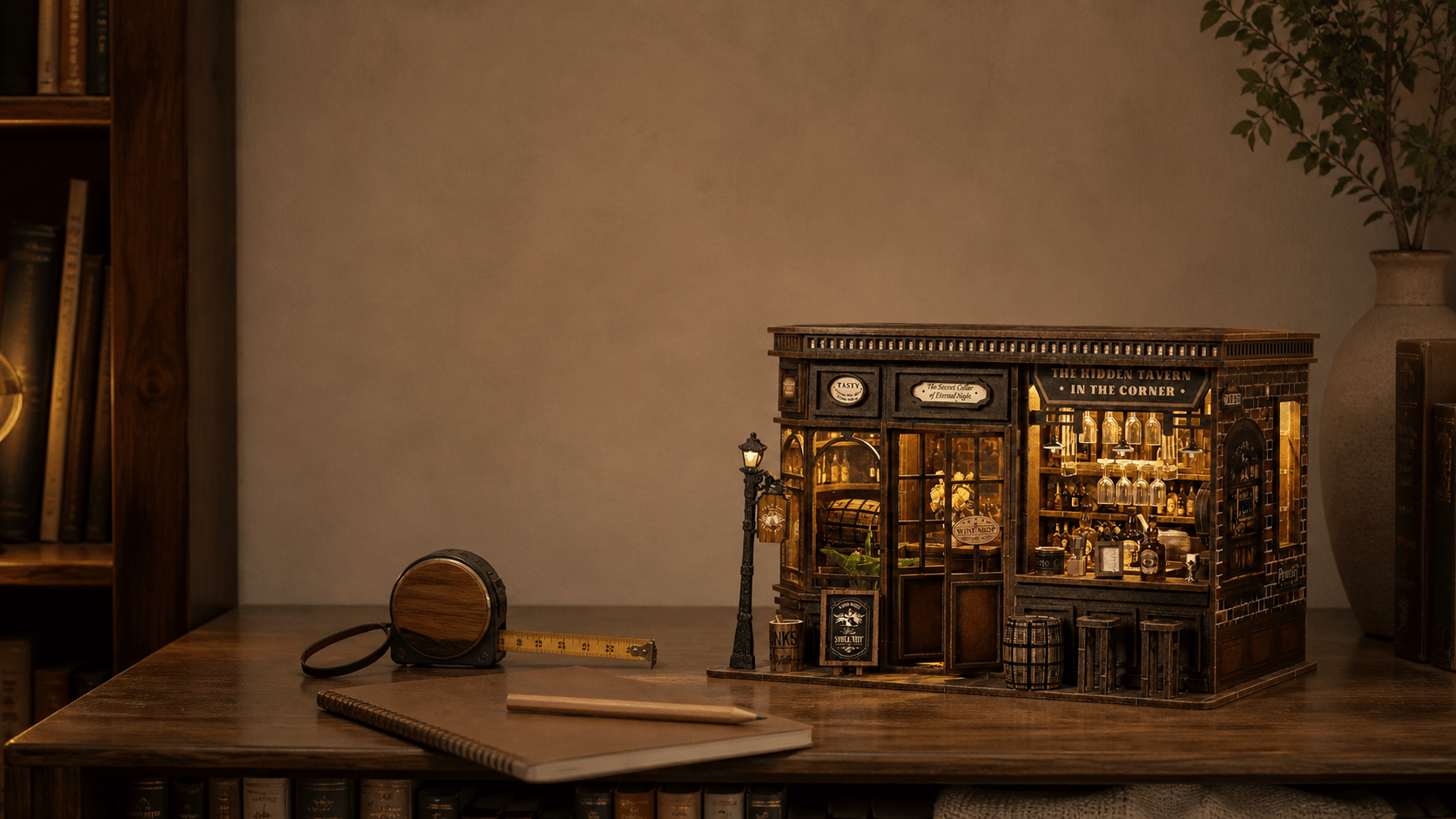
A miniature house kit is a flat-pack model you assemble yourself, usually from laser-cut wood, printed paper, cloth, and small findings, often finished with a string of warm LED lights. Some are freestanding cottages and shops. Some are book nooks designed to slide between the books on a shelf, so a lamplit alley or a tiny library appears to open up right there in the middle of your bookcase. Whichever form you are drawn to, the same five questions will tell you whether a kit is right for you.
Start with the finished size, not the box
The first thing to picture is where the finished piece will actually live. A model that looks generous on screen can turn out palm-sized in person, and a build you imagined on a windowsill might need a proper shelf. Before anything else, look at the listed finished dimensions and hold them up against the real spot you have in mind.
Size also changes the character of the build. Smaller pieces tend to have finer, more delicate parts, which can be charming but demands a steady hand and good light. Larger models give you more room to work and more presence on the shelf, though they ask for more space to display. If you are building a book nook specifically, measure the gap on your shelf and the depth behind it, because the illusion only works when the piece sits flush between the books. Our miniature house kits list finished dimensions on every product page for exactly this reason.
Read the piece count as a signal, not a scoreboard
It is tempting to treat a high piece count as better value, but that number is really a hint about the experience ahead. More pieces usually means more hours, more small steps, and more moments where patience matters more than skill. Fewer pieces means a quicker, cleaner path to something finished on your shelf.
What matters more than the raw count is the kind of pieces. A kit built from a few dozen larger wooden panels feels completely different from one with hundreds of tiny paper cutouts and thread. Neither is superior. One is a calm afternoon; the other is a project you savor across several sittings. Ask yourself honestly which one you are in the mood for, then let the piece count confirm it rather than lead the decision.
Match the difficulty level to your patience, not your pride
Most kits fall into three broad bands, and choosing the right one is the single best thing you can do to enjoy the build.
Beginner. Larger parts, forgiving assembly, clear steps. A great first build, a relaxed gift, or something to do alongside a child. Browse beginner kits if this is your first one.
Intermediate. More layers, finer detail, and some fiddly moments that reward focus. A comfortable step up once you know you enjoy the process. See intermediate kits.
Advanced. Intricate structures, many small components, and lighting or mechanisms that take real care to align. Deeply rewarding, but not the place to start. The advanced kits are for makers who already love the slow parts.
There is no prize for buying above your level. A beginner who picks a beginner kit finishes it, lights it up, and immediately wants the next one. A beginner who picks an advanced kit often stalls. Start one notch below where your ego wants to be, and you will build far more of these over time.
Be realistic about build time
Build time and difficulty travel together, but they are worth thinking about separately, because time is really a question of how you like to spend an evening. Some people want a single immersive Sunday; others want a quiet hour after dinner that stretches across a couple of weeks. Both are lovely. The mismatch to avoid is buying a long, demanding kit when what you actually wanted was one calm sitting.
Here is a rough way to think about it:
| If you want… | Look for… |
|---|---|
| A single relaxed session | A beginner kit with a lower piece count |
| A weekend project | An intermediate kit you can pause and return to |
| A slow, absorbing hobby | An advanced kit built across several evenings |
These are guidelines, not promises. Your own pace, workspace, and how often you stop to admire your progress all change the total. But going in with a realistic expectation is what keeps a build feeling like a treat instead of a chore.
Decide whether you want the lights
Warm LED lighting is what turns a nice wooden model into something that glows on a dark shelf, and it is the detail most people fall for. If a lit window at night is the whole reason you are drawn to these, prioritize kits that include lighting, and check how they are powered so you are happy with where the piece will sit. A book nook wedged into a bookcase, for instance, hides its battery pack and cable far more gracefully than a model out in the open.
That said, lighting adds a few steps and a little care during assembly. If you would rather keep your first build simple, an unlit kit is a perfectly good place to begin, and you can graduate to a lit one once the process feels familiar.
Let the theme be the tiebreaker
Everything above narrows the field. Theme is what makes you actually want to build the one you chose. This is where you should follow your taste without apology, because you will spend real hours with this little world and it should be a place you enjoy coming back to.
HiNooki leans into the scenes people find genuinely cozy: candlelit bookstores and libraries like the Wisdom Rings Library and the Dreamy Book Hall; a magic-school corner of the wizarding world; the lantern-lit streets of a Japanese alley; a warm little coffee shop or the Corner Tavern; and leafy garden houses for anyone who loves plants. Pick the world you would happily stare at every day, and the build takes care of itself.
A quick way to decide
If you want a shortcut, run through it in order: Will it fit the spot you have in mind? Does the piece count and difficulty match the effort you feel like giving? Is the build time the kind of evening you actually want? Do you want it lit? And finally, which theme makes you smile? Answer those five and you will end up with a kit you finish, light up, and feel proud to set on the shelf, rather than one that quietly defeats you.
When you are ready to start looking, the whole range of miniature house kits is organized so you can filter straight to the size, difficulty, and theme that fit you best.
Ready to pick the one you'll actually finish?
Browse the full range, filtered by size, difficulty, and theme, and find the little world you'll happily come back to.
Shop miniature house kits →
Partager:
Creative gifts for people who love to build things
3D wooden puzzles vs. book nooks: which kit is right for you?