


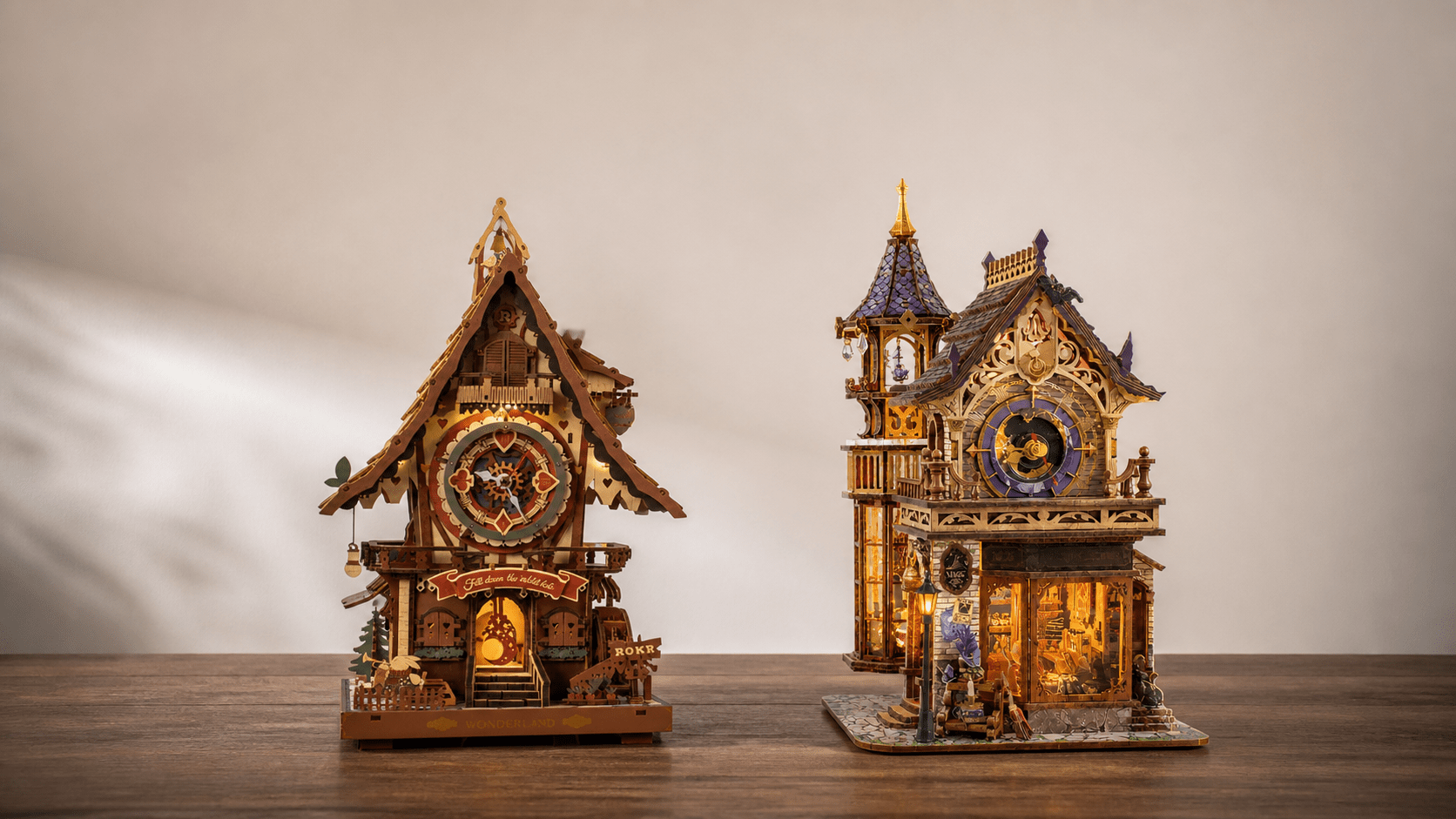
3D wooden puzzles vs. book nooks: which kit is right for you?
Two flat-packed boxes, two completely different evenings — here's how to tell which one belongs on your shelf.
If you've spent any time browsing handmade kits, you've probably kept circling back to two of them: the intricate 3D wooden puzzle that assembles into a little architectural object, and the book nook that slots between books on a shelf like a tiny lit scene. In a thumbnail they can look like cousins. In your hands, they're two very different evenings.
Both are laser-cut wood, both arrive flat-packed with a step-by-step guide, and both give you that quiet satisfaction of watching a pile of pieces turn into something worth keeping. But they build differently, they show off differently, and they suit different people. This guide walks through the real differences so you can pick the one that fits, whether it's a rainy weekend for yourself or a gift for someone who deserves a good one.
What is a 3D wooden puzzle, and what is a book nook?
A 3D wooden puzzle is a self-contained object. You fit precisely cut pieces together, usually with little or no glue, to build a structure that stands on its own: a mechanical contraption, a music box, a globe, a landmark. The finished piece is meant to be picked up, turned around, and looked at from every angle. Many have moving parts, which is half the appeal.
A book nook is a scene in a box. It builds into a slim, open-fronted diorama designed to sit upright between two rows of books, so it reads as a secret alleyway or room hidden on your shelf. Most are richly decorated inside, layered front-to-back for depth, and lit with a warm LED so the scene glows in the evening. It isn't handled after it's built; it's staged.
That single distinction, an object you hold versus a scene you frame, drives almost everything else.
How they build: the making experience
The two kits ask for different kinds of attention.
Mechanical thinking. A 3D wooden puzzle leans toward mechanical thinking. You're following how parts interlock, testing fit, and sometimes assembling gears or a wind-up mechanism. It can feel like solving a small engineering problem, and there's a distinct satisfaction the first time a movement actually turns. If you like precision and the reward of a thing that works, this is your kind of build.
Set design. A book nook leans toward set design. Much of the time goes into detail and atmosphere: papering tiny walls, placing miniature furniture, running the LED strip so the light falls where you want it. It's slower and more meditative, more like decorating a stage than solving a puzzle. If you enjoy the fiddly, absorbing work of making a space feel lived-in, a nook rewards that patience.
Neither is objectively harder. They're different muscles. Plenty of people love both for exactly that reason.
How they display: object vs. scene
This is where your shelf makes the decision for you.
A 3D wooden puzzle is a standalone piece. It wants a clear spot where you can see it in the round, a desk, a windowsill, a shelf with breathing room. It doesn't need surrounding books to make sense; it is the display.
A book nook is designed to disappear into a bookshelf and then surprise you. Slide it between two stacks of books, switch on the light, and a hidden world opens where a spine should be. It only fully works in that context, framed by books, ideally somewhere the LED can do its job after dark. If you have a full bookshelf and love the idea of a small secret tucked into it, few things land better.
Time, difficulty, and who each one suits
Both formats come in a range of difficulty, so the honest answer to "how long does it take" is "it depends on the kit you choose." Here's how they generally compare.
| 3D wooden puzzle | Book nook | |
|---|---|---|
| Feels like | Solving and building an object | Decorating and lighting a scene |
| Finished form | A standalone piece to hold and admire | A lit diorama that sits between books |
| Best displayed | Desk, windowsill, open shelf | Slotted into a full bookshelf |
| Great for | Tinkerers who like mechanisms | Readers and homebodies who love cozy detail |
| As a gift | Curious, hands-on makers | Book lovers and shelf decorators |
If you're brand new to either, it's worth starting with a kit matched to your patience rather than your ambition. HiNooki groups projects by challenge, so you can browse the beginner range first and move up to intermediate builds once you know you enjoy the process.
Choose a 3D wooden puzzle if
- You like mechanisms, moving parts, and the moment something clicks into place and turns.
- You want a finished piece you can pick up, rotate, and keep on a desk or windowsill.
- Your shelves are already full and you'd rather add a standalone object than a shelf insert.
Choose a book nook if
- You love the slow, absorbing work of styling a tiny, atmospheric space.
- You have a bookshelf and want a lit scene hidden among the spines.
- You're drawn to a particular world, a library, a wizarding street, a Japanese alleyway, a corner café.
Let the theme break the tie
If the build style and display leave you genuinely undecided, choose by the world you want to live with. That's usually the most honest way to pick, because you'll see the finished piece every day.
Book nooks shine when there's a story to step into. If you're a reader, a shelf scene like the Wisdom Rings Library or the Dreamy Book Hall feels made for you, and the wider bookstore and library collection is full of that mood. Prefer something with more spark? The wizarding world range leans into magic-school atmosphere, while Japanese street scenes and cozy café corners like the Corner Tavern trade spell-glow for lantern light and warmth.
And there's no rule that says you have to pick just one. Many makers start with whichever theme they can't stop thinking about, then come back for the other format later. A puzzle for the desk, a nook for the shelf; between them, they cover both kinds of quiet evening. If you're still weighing it up, browsing the best sellers is a good way to see what other people reached for first.
Find the kit that fits your kind of evening
Object you hold or scene you frame — start with the world you can't stop thinking about, and build from there.
Shop best sellers →
Partager:
Creative gifts for people who love to build things
How to choose a miniature house kit: size, pieces, and build time