


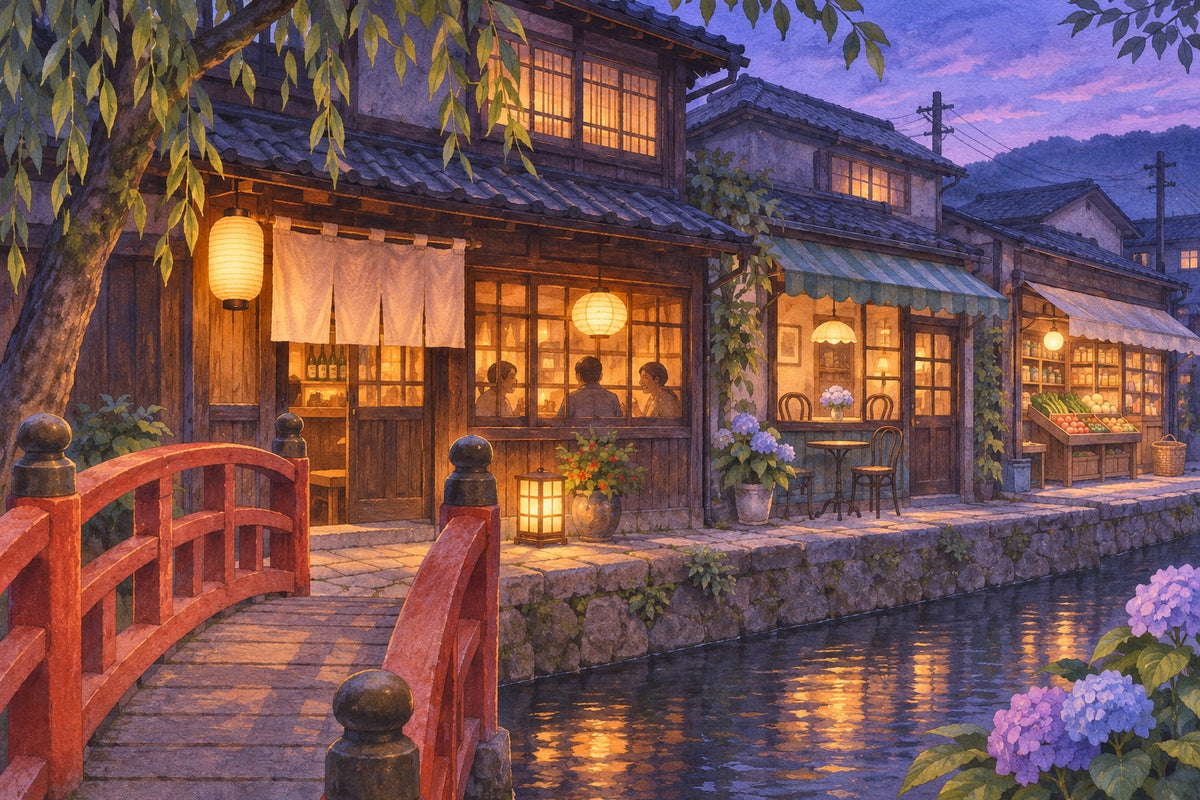
Pick a Japanese miniature house kit by what you would most enjoy making. Choose a riverside tavern for a build that moves from the building to the counter and garden. Choose a retro café if you want a shorter project centered on furnishing a room. Choose a neighborhood grocery if the fun is filling shelves with tiny everyday things. Before you decide, check how much room the finished model needs and which parts of it you’ll want to leave in view.
A riverside tavern for a build you can split into stages
If you enjoy making the outside of a building as much as furnishing the inside, look for a scene with something to build at the doorstep. A bridge and pond give you a landscape to work on alongside the house. An upper room adds a second interior, so you can spend one session on the structure and save the smaller details for another.
In Bridgeside Machiya, a low red bridge leads to an izakaya, a Japanese tavern, with stools at the counter and a quieter tea setting above. The listing gives a 6–8 hour assembly estimate and finished dimensions of 16 × 14.4 × 22 cm. Set it where you can see the bridge and both floors at once, and leave space on the right for the fish streamers.

A retro café if you like furnishing a room
An open-front café gives the small things room to show, from cups to what’s sitting on the shelves. Look at a finished front view before buying. If you can see the pieces you’re most excited to arrange without having to turn the building, it will be easier to enjoy from the desk or shelf you have in mind.
Showa Teahouse is listed at 4–5 hours and measures 16.8 × 14 × 18.7 cm when assembled. Its open front shows the tables and a little television, and an opening side lattice window gives you another view. If you’re choosing between this and the tavern for a first build, the café has a shorter listed estimate and a lower roof. Leave the side window clear if you want to open it.
A grocery if stocking the shelves sounds like the fun part
A shop with an open front gives you a view of details you might miss in a room behind a closed façade. Check the finished photo from the side, too. A tree, a sign or a rack outside the entrance is part of the view, so leave a little space beyond the edges of the base.
Kasuga Grocery Store is about 17 cm tall when built. Its shelves hold miniature drinks and snacks, with a magazine rack and a white vending machine outside. The curved tree frames the side window, so try placing the model at the end of a shelf where you’ll see both views.

Before you order
- Picture the build. Working on furnishings feels different from setting out tiny food packages or building a bridge. Pick the work you’ll look forward to once the walls are up.
- Check the actual space. Measure the shelf depth and height, then look for doors, awnings or side details that might need a little more room. Let the whole base rest on a stable surface.
- Check the kit listing for supplies. See how the lights are powered and what you’ll need to prepare. All three examples are DIY kits you build yourself.
For a gift, match the scene to a place the recipient loves. The riverside tavern suits someone who always notices old buildings, the café suits someone who lingers over the details in a room, and the grocery is for the person who looks at every packet in a corner shop.
Partager:
How to Make Miniature Bread With Air-Dry Clay
Christmas Book Nook or Miniature House? What Fits Your Shelf