


The science behind why miniature building calms your mind
Why an hour with a tiny wooden room quiets a loud day, and how to reach that calm on purpose.
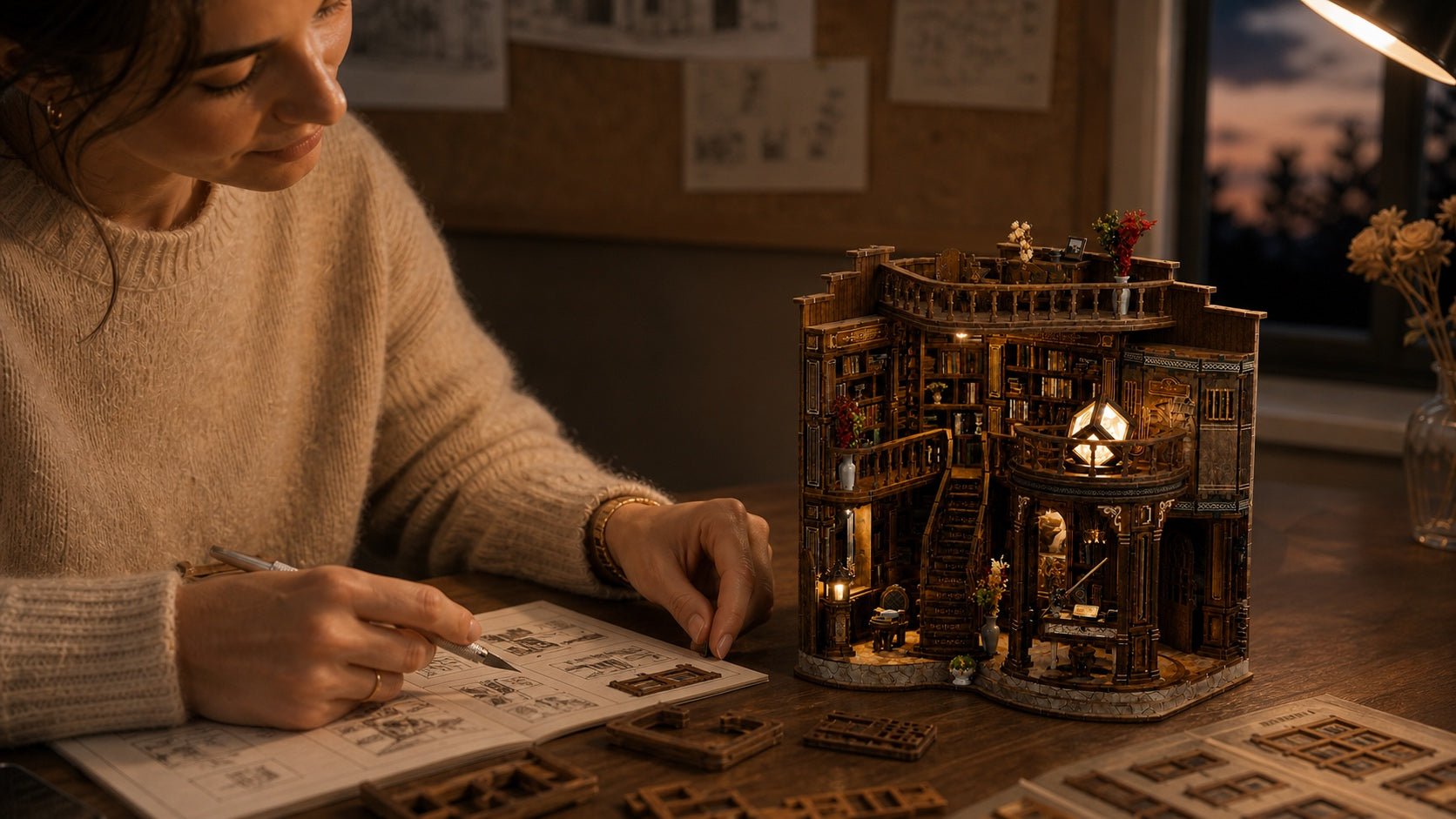
Most people notice it before they can explain it. You sit down to place a few tiny beams, glue a lamp into a doorway, thread a warm little light behind a paper window, and somewhere in there the noise in your head goes quiet. An hour passes. Your shoulders have dropped. You are not thinking about the email you owe anyone. There is just this small wooden room in front of you, and the one piece your hands are working on next.
That calm is not your imagination, and it is not only about the finished piece looking lovely on a shelf. Miniature building sits right on top of several ideas about attention and rest that are widely accepted and easy to feel for yourself. None of it requires you to be crafty or patient by nature. Here is what is actually going on when a tiny library quiets a loud day.
Why miniature building works as stress relief
The short version: it gives your mind one small, absorbing thing to do, and small absorbing things are where a busy brain finally gets to rest. Most stress is not caused by a single big problem. It is caused by attention being pulled in ten directions at once, none of them finished. A miniature kit is the opposite of that. It is one clear task, broken into many little steps, each with a beginning and an end you can see.
When your hands are occupied and the next step is obvious, the churn of open loops in your head has less room to run. Many makers describe it the same way: the worry does not get solved, exactly, it just gets crowded out by something gentler and more concrete. That is a real and repeatable kind of relief, and it is a big part of why a calming hobby beats simply telling yourself to relax.
Flow: the state a good kit is built to trigger
Psychologists have a well-known name for the feeling of being pleasantly lost in an activity: flow. It tends to show up under a specific set of conditions, and a miniature build happens to check nearly all of them.
A clear goal. You know exactly what you are making. The picture on the box is the goal, and every session moves you visibly closer to it.
Immediate feedback. A wall goes up. A light turns on. A staircase clicks into place. You see the result of each move right away, so you always know if you are on track.
The right level of challenge. A build is hard enough to hold your attention but not so hard that it becomes frustrating, especially if the kit matches your experience. This balance is the single most important ingredient of flow.
That last point is worth taking seriously when you choose a project. A kit that is too fiddly for a first-timer creates stress instead of dissolving it, and one that is too simple stops holding your focus. If you are new to this, starting with a beginner-friendly kit is not settling for less. It is the surest way to actually reach the calm state, because the difficulty sits where your attention can rest in it comfortably.
Working with your hands is its own kind of quiet
There is something specific about hands-on making that a screen cannot copy. Cutting, sanding lightly, aligning a wall, dabbing glue, waiting for it to set, positioning a lamp so the light falls just right: these are slow, physical, tactile motions. They pull your attention down out of your head and into your fingertips.
This is close to what mindfulness practice is reaching for, only you arrive there sideways instead of by trying. You are not instructed to be present. The task simply requires it. You cannot glue a beam crookedly and think about tomorrow at the same time, so for a while you are fully here, doing one small careful thing. Many people who find sitting meditation difficult discover that a craft like this gives them the same settled feeling without the effort of forcing their mind to be still.
A screen-free hour, on purpose
Part of why building a miniature feels so restful is simply what it is not. It is an hour with no feed to scroll, no notifications competing for the next glance, no autoplay pulling you to the next thing. Your attention gets to stay in one place long enough to actually deepen, which is a rare experience in an ordinary day.
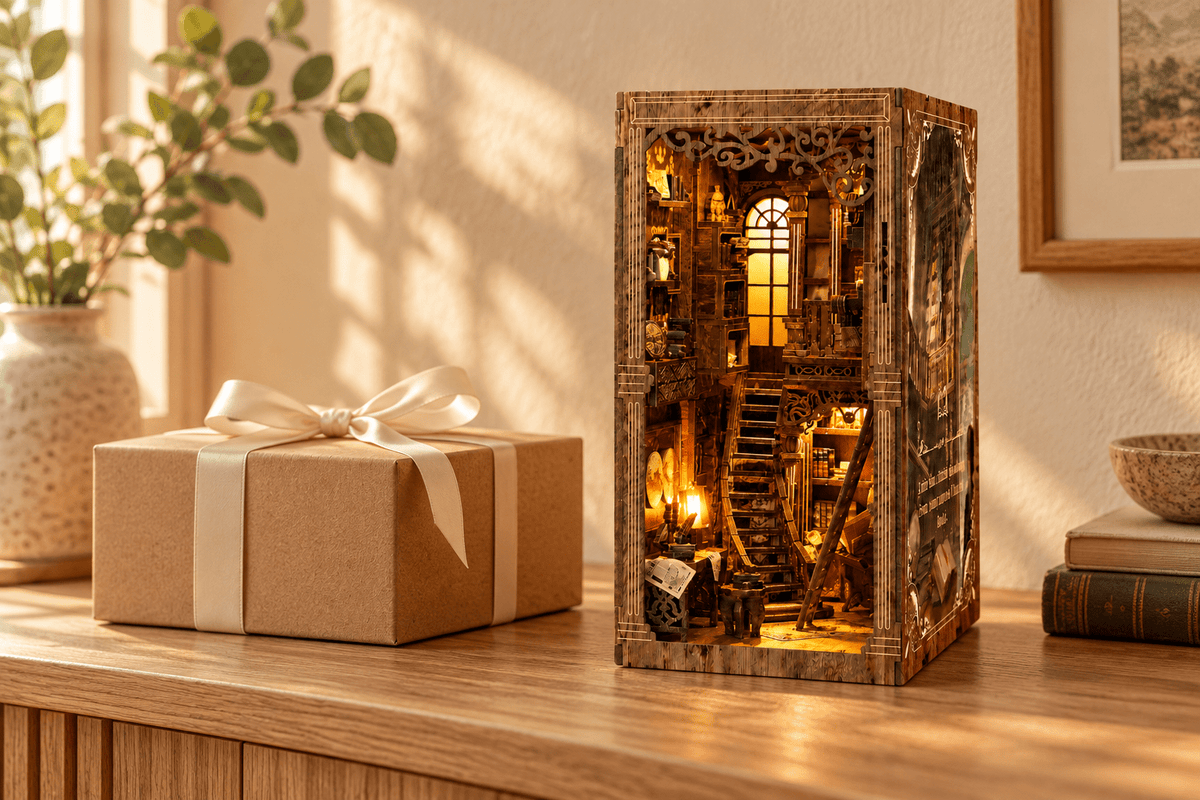
This is why so many makers reach for a kit specifically in the evening, as a way to come down after work or before bed. Screens tend to keep the mind revved. A warm, quiet, low-light task like fitting together a tiny book nook to slot between the books on a shelf does the opposite. The pace is slow by design, and the reward is a small glowing scene rather than another dopamine spike that leaves you wanting more.
The satisfying part: a finished thing you can hold
A lot of modern work is abstract. You send things, you reply to things, and at the end of the day it can be hard to point at what you actually made. A miniature build gives you the opposite: a small, complete, physical object that did not exist this morning and now sits finished in your hands.
That sense of visible completion is quietly powerful. It is a clear ending, which office work so often lacks, and it comes with a genuine little lift of pride each time you place the final piece and switch on the light. The theme you choose shapes the mood of that reward, and that is part of the pleasure too. A hushed, lamp-lit library or bookstore scene lands differently from a cozy corner tavern or a quiet street at dusk, and it is worth picking one that matches the feeling you want to sink into.
How to actually get the calming effect
The settling feeling is not automatic. A few small choices make the difference between a relaxing hour and a frustrating one.
- Match the kit to your skill. Start where the challenge feels comfortable, not heroic. You can always level up next time.
- Give yourself a real block of time. Flow takes a while to arrive. Ten stolen minutes rarely gets you there; an unhurried hour usually does.
- Set up your space first. Good light, a clear surface, your pieces sorted. Fumbling for a lost part is the fastest way to break the spell.
- Let it be slow. There is no prize for finishing quickly. The slowness is the point, and rushing quietly cancels the benefit.
- Do not aim for perfect. A slightly imperfect little house is still a lovely little house. The calm comes from the doing, not from flawlessness.
Screen time versus build time, side by side
The same evening hour, spent two ways, tends to leave you in very different places.
| Winding down with a screen | Winding down with a build |
|---|---|
| Attention is pulled outward, constantly | Attention rests inward, on one task |
| Endless feed, no natural stopping point | Clear steps, a clear finish |
| Often leaves you a little more wired | Tends to leave you calmer and settled |
| Nothing to show at the end | A finished object you can keep and display |
You do not have to take any of this on faith. The next time an evening feels frayed, put the phone in another room, pour something warm, and spend an hour building one small lit-up world. Notice where your mind goes, and where it stops going. If that sounds like the kind of quiet you have been missing, a gentle first project from our book nook collection or an easygoing pick from the beginner range is a good place to start.
Build one small lit-up world tonight
Put the phone in another room, pour something warm, and let an hour go quiet with a kit that meets you where you are.
Shop book nooks →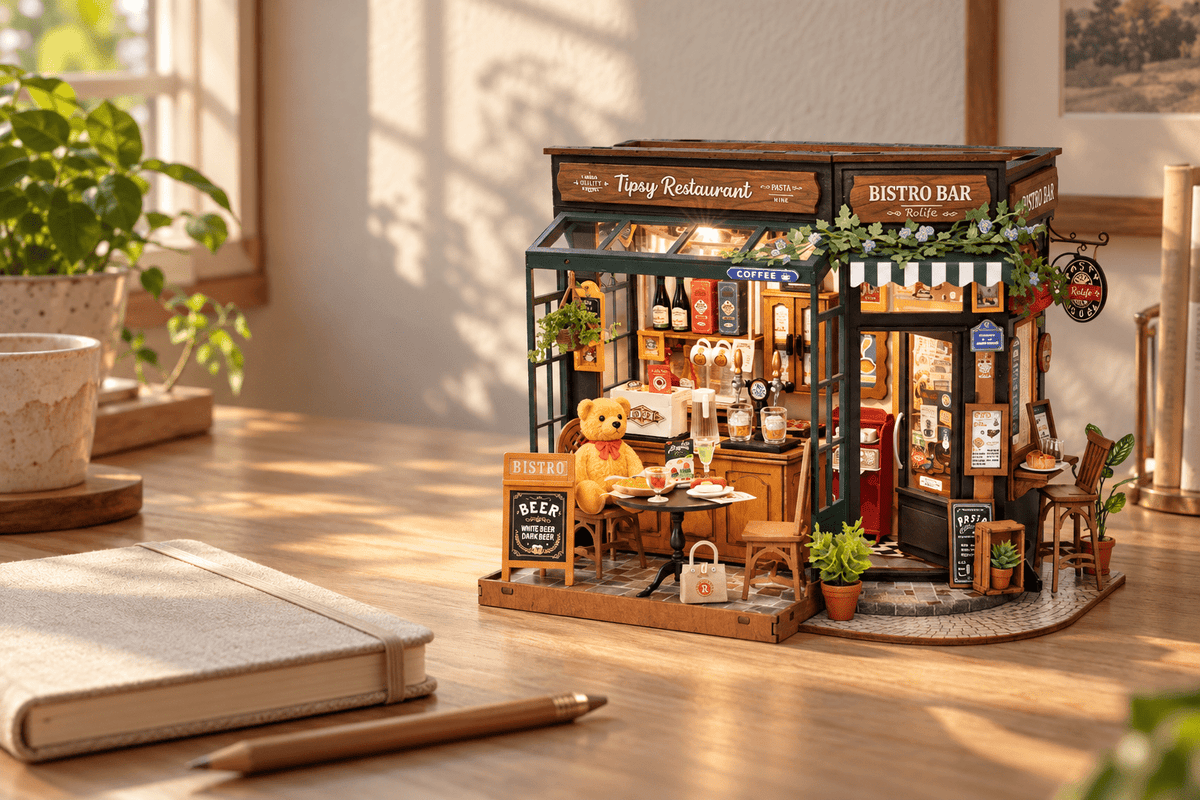

Teilen:
Book nooks for fandom lovers: wizarding, anime and fairy-tale worlds
Book nook themes for every aesthetic: cottagecore, wizard, Japanese street