


The last piece is in place. Your first miniature has a home, and you are already looking at another. Before you choose, pause over a more useful question than “What is harder?”: which part would you happily do again?
Your first build gives you something a product listing cannot: a sense of how you like to make. Use that experience to choose a second miniature kit that suits your hands, your evenings, and the space you want to fill.
Look back at the work, not just the finished scene
Think of three moments from your first project: one you enjoyed, one you put off, and one you wished would last longer. Be specific. “I liked the café” tells you less than “I loved arranging the cups and furniture.” “It was fiddly” becomes useful when you can name the task that felt fiddly.
Perhaps fitting the walls together was satisfying, while repeating tiny paper details felt slow. Perhaps the structure was simply the route to your favourite part: making a room look lived in. Neither preference is a measure of how good you are. It is a clue about what to look for next.
Also separate the task from the conditions. Searching for misplaced pieces on a crowded table is different from disliking small parts. If packing away interrupted your momentum, a better storage routine may help more than a different kit. Our guide to storing an unfinished miniature between sessions is a useful place to start.

Choose one direction for your next build
You do not need a complete change to keep the hobby interesting. Choose the direction that sounds appealing now.
Repeat the feeling
If the first kit left you wanting more of the same, choose a different scene with familiar kinds of work. A similar level of complexity can give you room to practise cleaner alignment, tidier placement, or a more comfortable pace. Repetition can be a deliberate choice.
Change the subject
If the making process suited you but the theme no longer excites you, try a different setting. Moving from a bedroom scene to a shopfront can change the finished mood without requiring you to seek a more demanding project. Check the actual construction and materials, though: a new theme does not guarantee a familiar process.
Add one new challenge
If you want to stretch, name one thing you would like to learn. It might be assembling a different kind of structure or working with a material you have not tried. Look for clear product information about that feature. Changing the scale, construction style, and detail density all at once makes it harder to judge which new element you will enjoy.
Read the next product page through that lens
Look at close-up photographs as carefully as the main image. Notice the balance of walls, furniture, small decorative objects, and repeated elements. Then check the description for assembly requirements and materials. Photographs show the destination; they may not show every step needed to get there.
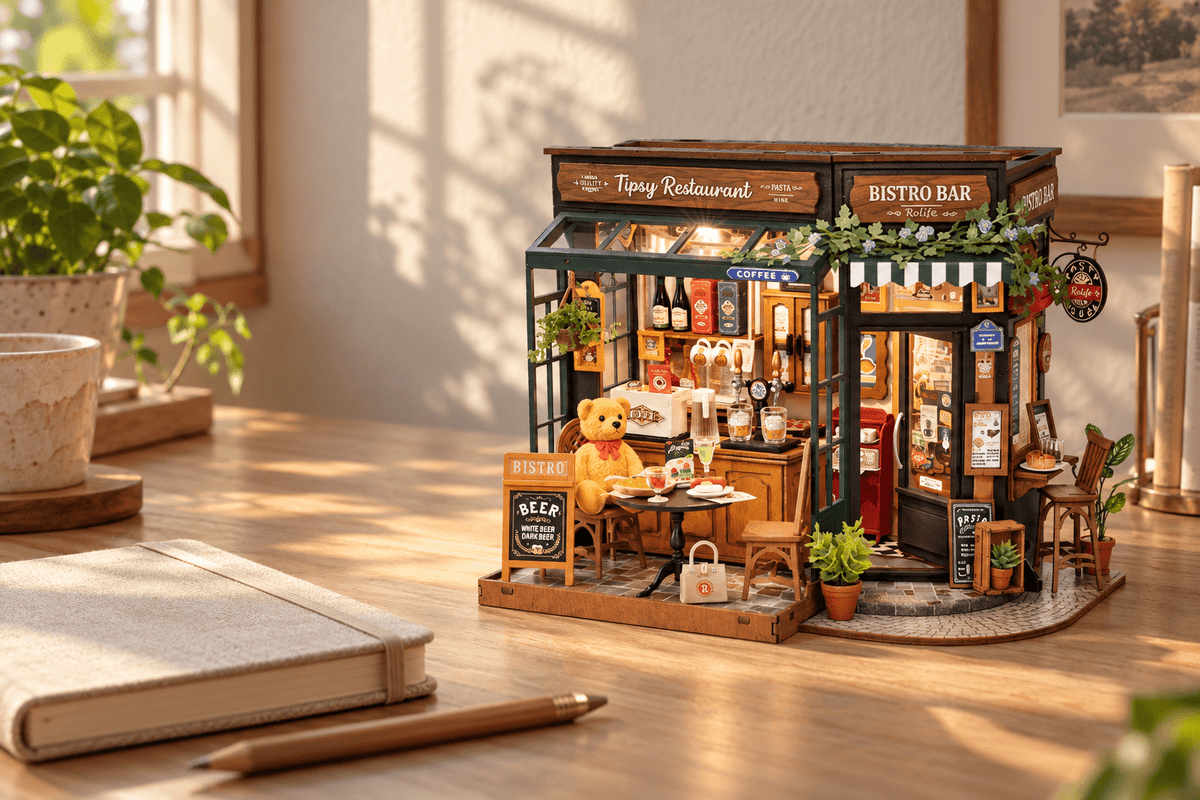
For example, Tipsy Restaurant is a DIY miniature house kit built around a French-style bistro. Its green frontage, furnished bar, small dining table, and seated yellow bear give you several distinct details to consider. If miniature furniture and little everyday scenes were your favourite part of a previous build, those details may make it a relevant candidate. If you want fewer small objects, study the close-ups before deciding.
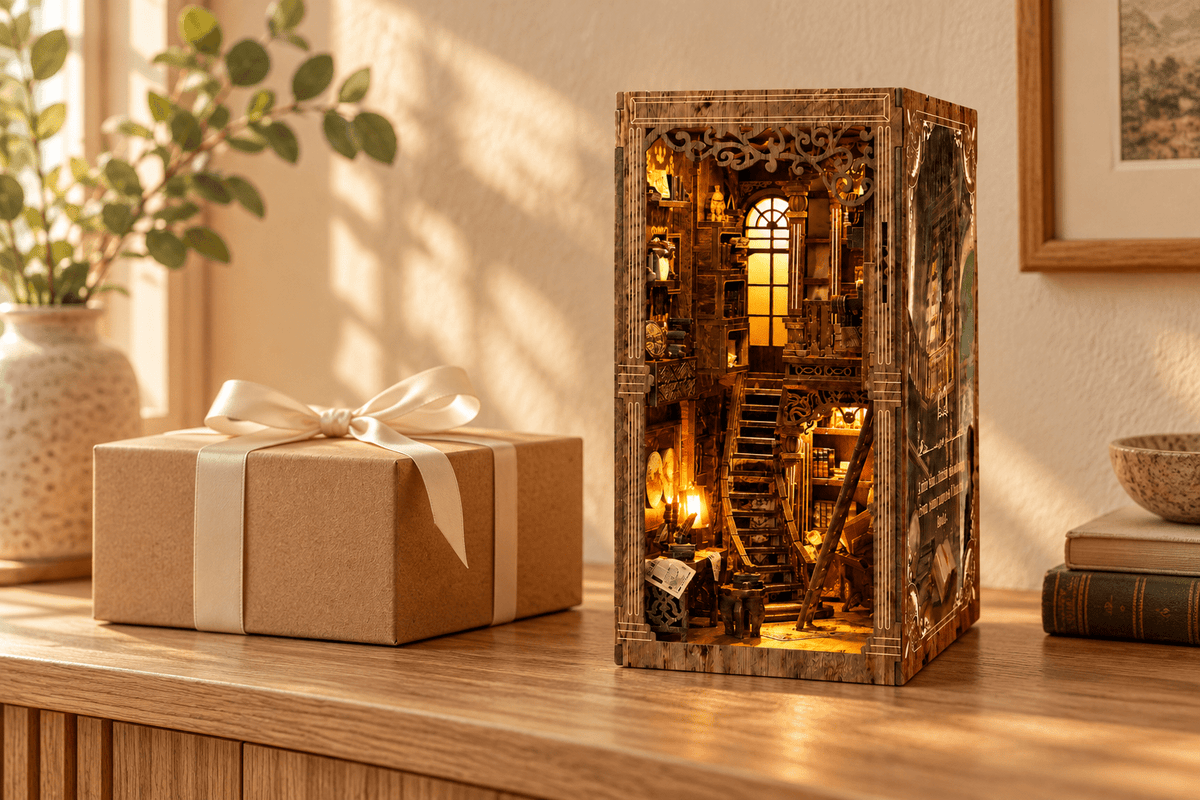
This is an example of matching a kit to an interest, not a claim that it is the right second project for everyone. Tipsy Restaurant requires assembly and is a standalone miniature scene, rather than a book nook insert. Check its current product page for the full specifications and requirements.
Give the finished piece a destination
Before ordering, decide where the next model could live. Check the listed assembled dimensions against the usable depth, width, and height of that space. Leave room to see the details, reach the model safely, and access any controls described on its product page.
A pair of models does not need to match exactly to feel considered. You might connect them through a colour, a setting, or simply the things you enjoy. Keep enough space between them that each still reads as its own small scene.

Make a short brief before you browse
Finish these three sentences: “I want more of…”, “I would prefer less of…”, and “This time I am curious about…”. Add where you will build and where the finished piece will go. That is enough to turn an open-ended browse into a useful shortlist.
For instance: “I want more furniture and scene details. I would prefer fewer repeated tasks. I am curious about a restaurant setting, and I have space on the sideboard.” You can now compare candidates against those wishes, rather than letting the most elaborate photograph make the decision.
Keep the practical checks from your first purchase, too. Our guide to miniature kit size, piece count, and build time can help with those. Treat any estimated assembly time as a guide, then plan around the pace you learned from your own first build.
Your second kit does not have to prove anything. Choose a project whose ordinary steps sound appealing—not only one whose finished photograph you admire.
Image note: The cover and two article scenes were created with AI using real HiNooki Tipsy Restaurant product photographs as references. They illustrate display settings, not kit contents. The product is a DIY kit requiring assembly; surrounding room décor and stationery are styling props. Refer to the product page for original photographs and specifications.

Teilen:
Give the Kit or Build It First? A Miniature Gift Guide