


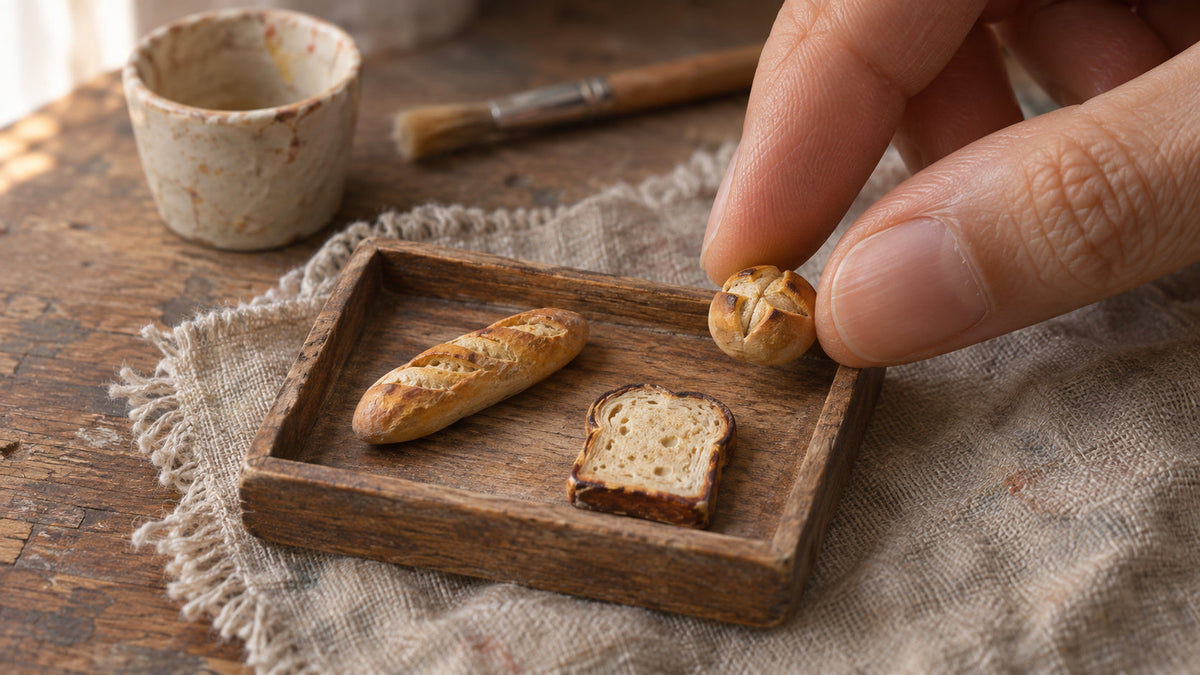
To make miniature bread with air-dry clay, size one piece to fit your scene, shape it while the clay is soft, then let it dry completely before painting the crust. A round roll, a short baguette and a slice of toast make a good first batch. Each uses the same materials, and you can tell the three shapes apart even when they sit at the back of a book nook.
Set out a small piece of fine-textured air-dry clay, a smooth work tile, a toothpick, a ruler and a small brush. For color, use cream, golden ochre and brown acrylic paint if your clay's instructions allow it. Keep a small offcut for testing the paint. These are decorative props for a miniature scene.
Find the size with a paper cutout
Pick the plate, tray or counter where the bread will sit. Cut a paper oval to the length you're considering and place it in the scene. If it crowds the tray or looks wider than a nearby plate, trim the cutout before you touch the clay.
If you know the scale, divide a real measurement by its denominator. A 72 mm roll becomes 6 mm at 1:12, or 3 mm at 1:24. A short 240 mm baguette becomes 20 mm or 10 mm at those same scales. These are starting points. If your scene has no stated scale, judge the paper shapes alongside the furniture and dishes you already have. For more worked examples, see our guide to miniature scales.
Measure one clay test piece after it dries. If it has shrunk enough to look wrong beside the plate, adjust the next batch using the dried sample as your guide.
Shape three kinds of bread from one piece of clay
A round roll
Roll a small ball and press it lightly on the tile to make a flat base. Keep the dome high. Draw a shallow slash across the top with a toothpick while it is still soft. Try one slash on the smallest rolls. A deep groove can split the silhouette into two halves.
A short baguette
Roll an even cylinder, taper both ends gently and flatten the underside just enough for it to sit on the tray. Mark the top with two or three short diagonal lines. Leave space between them so the marks read as cuts in a crust. At a small scale, two clean marks may be easier to see than four crowded ones.
A slice of toast
Press a small clay piece into a flat shape. Straighten the lower edges with the side of a toothpick and round the two top shoulders. Touch the broad face with the toothpick tip in a scattered pattern to suggest crumbs. Leave a slim, smooth border so you can paint the crust as a continuous edge.

Let the clay dry, then build color in thin layers
Set the pieces aside on the surface recommended for your clay. Use the drying time on the package. Wait until they are dry throughout before painting, especially if the roll is much thicker than the slice. Try the paint on your dried offcut first to see how it looks after it settles into the clay.
Start with a pale warm base. Brush golden color over the outside of the roll and baguette. When it dries, lightly add brown on the highest part of the dome and along the shoulder of the loaf, leaving the recessed cuts lighter. For toast, paint a narrow brown edge and keep the broad center cream. A few warm flecks on the face are enough to give the slice some depth.
If the brush fills the texture, wipe off excess paint on scrap paper before the next pass. If the color looks flat, add a little warmth only where a crust would darken. At shelf distance, the contrast between the pale cut and the toasted surface does more than an extra row of pinholes.

Place the bread where it tells part of the story
Try the bread loose before fixing it in place. A single roll beside a cup suggests breakfast. Two short loaves toward the back of a tray make a bakery counter feel stocked while leaving the front edge visible. Turn a slice slightly toward the viewer if the toast is hard to recognize from the opening of a book nook.
Look at the piece from where you usually see the scene. If the bread disappears, move it into the light or simplify the objects around it. If it becomes the first thing you see in a room where it should be a small detail, try fewer pieces or a smaller tray. Our guide to making miniature houses look more realistic shows how details can work together across an entire scene.
Start with the roll and let it dry before making a trayful. Once it looks right next to the pieces you already have, use the same scale for your loaf and toast.


Teilen:
Gifts for Mystery Lovers: Puzzles to Solve, Worlds to Build