


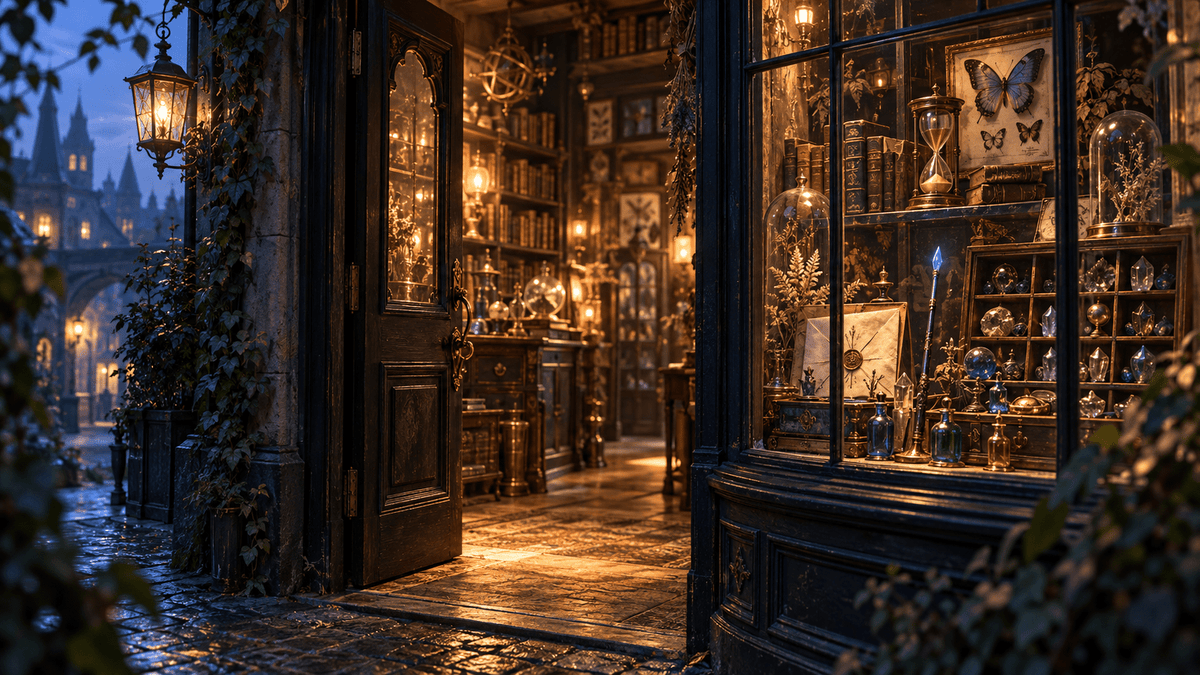
A fantasy book nook kit can give you a tiny shop to peer into, a street that seems to disappear between your books, or a wizard’s room crowded with spellbooks. Those scenes can look equally inviting online, yet offer quite different things to build and display.
Start with the view you want to keep: choose a shop for small objects and a recognisable storefront, an alley for depth and architecture, or a study for books, furniture and layered interiors. Then check whether the build and the available shelf space suit you. Here is how those choices play out in three HiNooki kits.
Three fantasy scenes, three different reasons to choose
- A magic shop: Magic Oddities Store suits someone who wants to examine one little place closely, including its window display and opening door.
- A mysterious alley: Magic Night Alley suits someone drawn to crooked shopfronts, hanging signs and a cobbled route into the scene.
- A wizard’s study: Magic World suits someone who would rather assemble shelves, books and furniture inside a richly furnished room.
This is a comparison of scene types, not a difficulty ranking. All three are DIY kits requiring assembly. The differences below are based on their current product photographs and listings, rather than a hands-on build test.
Choose a magic shop if you enjoy discovering small objects
The pleasure of a shop scene is stopping at the window. In Magic Oddities Store, the dark framing gathers your attention around a blue-tipped wand, bottles, a sealed letter and a cabinet of colourful curiosities. The opening door provides another way to look inside.
That makes it a good choice for close viewing: beside your reading chair, on a desk or on a shelf you often pass. You are choosing one concentrated little destination. If your favourite detail in a fantasy story is the shopkeeper’s collection, this format gives that collection room to matter.
The trade-off: a storefront does not offer the long view of a street. Its small objects also lose impact when you display it high above eye level or behind other decorations. The listed footprint is approximately 12.2 × 12.1 cm, but you need additional room for the door to swing and for access to the lighting control.

Choose a fantasy alley if you want a view into another world
An alley uses buildings and a path to lead your eye further into the model. Magic Night Alley combines tall bay-fronted buildings, curved shop windows, hanging signs and a cobbled lane. The blue stone-pattern frame helps the opening read as a passage through the bookshelf.
This is the direction to explore if you want a strong front view between novels. Look at the path in the product photographs: can your eye follow it past the foreground objects? A route through the scene is more relevant to this choice than simply counting how many tiny accessories are included.
The trade-off: the scene needs a clear opening. A neighbouring book leaning across the front can hide the street’s perspective. The build also involves repeated architectural details such as windows and signs, so choose it because those tasks appeal to you as well as the finished glow.

Choose a wizard’s study if books and furniture are the attraction
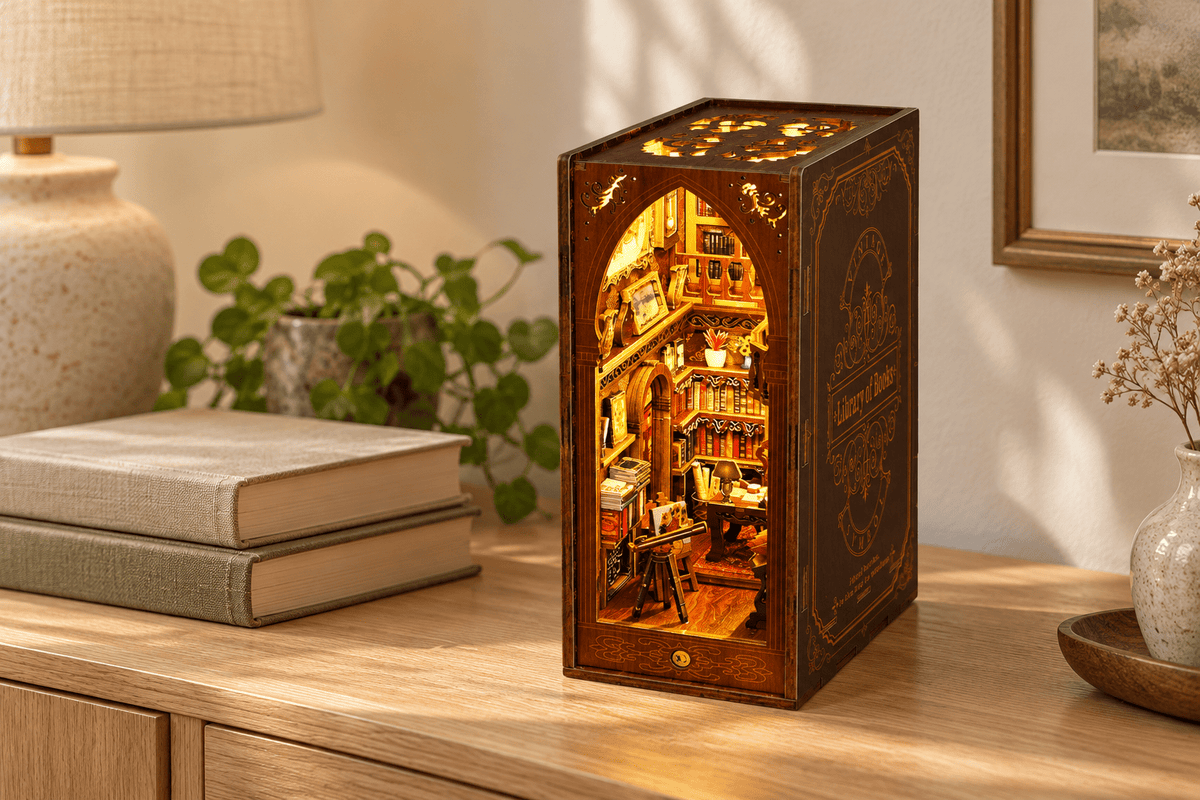
A study brings the fantasy indoors. In Magic World, a burgundy, book-shaped frame surrounds an ornate writing desk, shelves, a ladder and a raised stairway. A black cat and a pale owl sit among the furnishings. Your attention moves up and around the room rather than down a street.
This suits a reader who likes the idea of a hidden working room: the desk where a spell might be written, the shelf where a particular book belongs. Before choosing, enlarge a photograph of the interior. If arranging miniature books and finishing the furniture looks enjoyable, the making process is likely to match the part of the scene you love.
The trade-off: a dense interior asks you to appreciate several small focal points. It will not have the simplicity of one shop window or the open route of an alley. Leave the front visible and enough space to appreciate the decorative frame, rather than surrounding it with equally busy ornaments.

Which build will you actually enjoy?
A dramatic photograph cannot tell you whether you will enjoy repeating a particular assembly task. Look for the work behind the scene: window frames and signs in an alley, little display objects in a shop, books and furnishings in a study.
Do not use piece count as a difficulty score. Magic Oddities Store lists 149 pieces and an intermediate rating; Magic Night Alley lists 298 pieces. That does not establish that one takes twice the effort. Part size, the assembly sequence and your comfort with detail work matter too. Check the current instructions and difficulty information for your shortlist. If you are new to the hobby, our beginner’s guide to book nook kits explains the basic preparation.
Check the shelf and the functions before you order
Measure the usable space, not just the gap between book spines. Compare the listed width, depth and height with your shelf. Leave access for switches, batteries and any opening parts. A shop door needs clearance; an alley needs an unobstructed sightline; a study needs a position where its interior remains visible.
Separate lighting from movement. All three listings include LED lighting. Magic Oddities Store also has an opening door; Magic Night Alley has a lift-up section of paving over decorative coins. Magic World’s owl, cat and books are scene details, not advertised moving features. Buy for the functions the listing actually describes.
Check what you need to supply. Magic Oddities Store specifies two AA batteries, which are not included. Do not assume the same battery type, adhesive requirements or included accessories apply to every kit. Confirm those details for the model you choose before planning your first building session.
Make your shortlist in one minute
Pick the sentence that sounds most like you:
- “I want to look through a window and discover tiny treasures.” Start with Magic Oddities Store.
- “I want my bookshelf to open onto a mysterious street.” Start with Magic Night Alley.
- “I want to furnish a secret room full of books.” Start with Magic World.
Then open the product photographs, choose three details you would enjoy making, and check the display space. If you are still deciding between fantasy, gardens and everyday street scenes, our book nook theme guide offers a broader starting point.
Product details are based on current HiNooki listings and product photographs. The cover is an AI-created fantasy illustration, not a product photograph. The three body scenes were created with AI using photographs of the actual products as references; surrounding furniture, full-size books and styling props are not kit contents.
Teilen:
Which Miniature Flower House Should You Build?