


Do book nook kits include everything? A first-timer's checklist
What arrives in the box, what to prepare separately, and which details to check before your first build.
If you've been eyeing a book nook to slot between the spines on your shelf, there's usually one quiet question holding you back: what actually arrives when the box lands on your doorstep? Is it a finished piece, or a pile of parts and a prayer? Do you need a workbench full of tools, or just a free afternoon? It's a fair thing to wonder before you spend anything, and the honest answer is reassuring, with a couple of small caveats worth knowing up front.
This is a first-timer's checklist, written to settle the nerves rather than sell you on anything. Here's what a book nook kit typically includes, what it usually doesn't, and the handful of everyday items you might want within arm's reach.
What a book nook kit usually includes
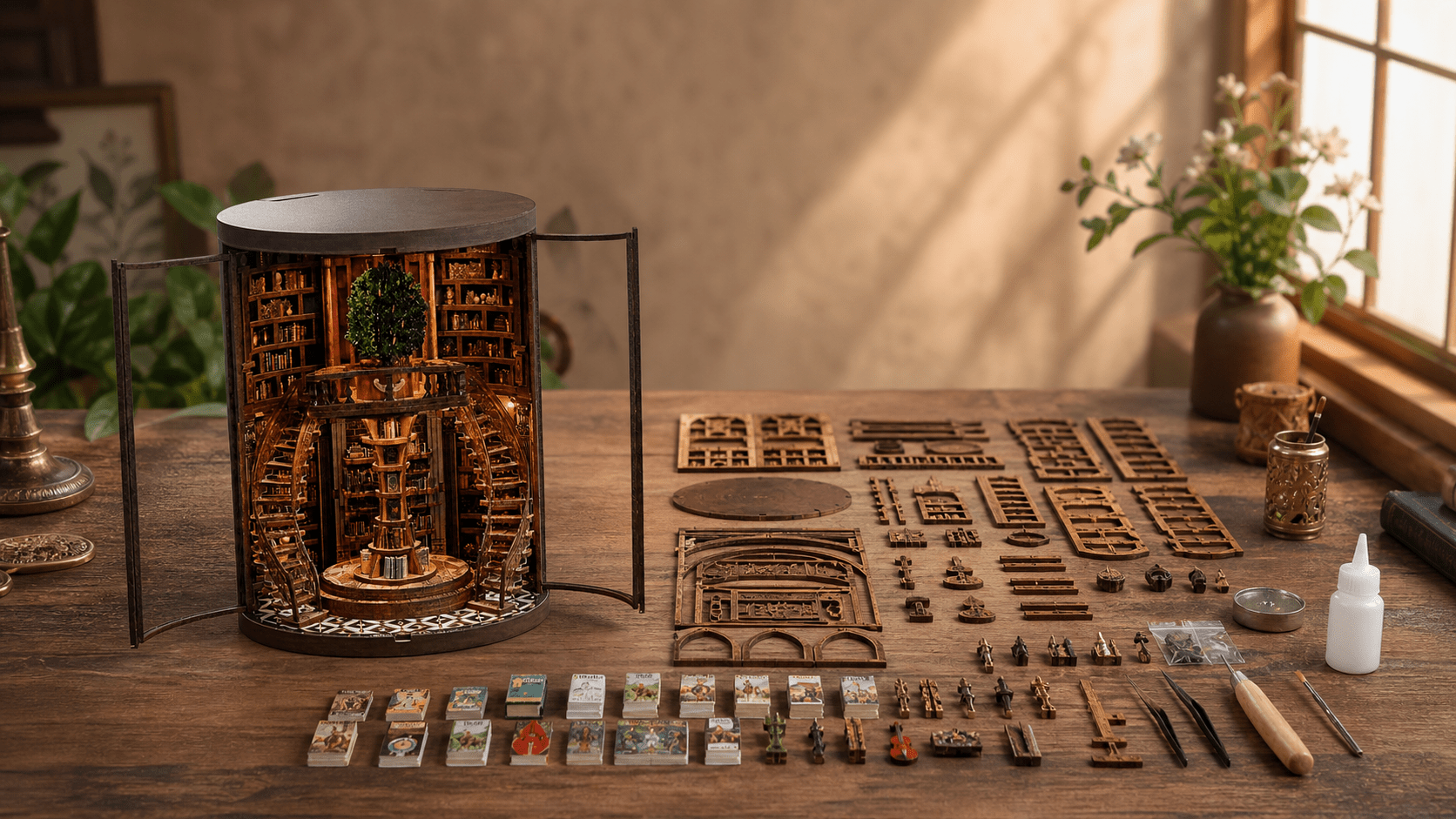
A book nook is a kit, not a ready-made ornament. That's the whole point: you build the little scene yourself, and the finished piece feels earned. Kits provide the model parts, while adhesives, power supplies and tools depend on the design. While specifics vary from design to design, a typical kit tends to include:
- Pre-cut wooden pieces. The walls, floors, stairs, window frames and small architectural details usually come laser-cut and ready to detach from their sheets. You're assembling shapes, not carving them, so there's no sawing or measuring on your part.
- Printed paper and decorative sheets. Many designs use printed cardstock or paper for facades, signage, tiny book spines, wallpaper and backdrops. These give a scene its character and are usually included, pre-printed and ready to place.
- Small parts and fittings. Depending on the theme, this can mean miniature furniture, lanterns, plants, barrels or other props that bring the scene to life.
- LED lighting. A lot of book nooks are built around that warm glow spilling out from a window or doorway. HiNooki light-up designs include LED lighting components, but the power source varies: some use USB power and others use batteries. Check the exact product specification for the required power source and what is included.
- Illustrated instructions. Step-by-step assembly guides, usually with diagrams and numbered parts, walk you through the build in order.
Check the listed contents before you start: model parts, lighting where applicable, tools and extras vary by design. If you're browsing our book nook collection, the individual product pages are the place to confirm what a given design comes with, since themes differ and so do their contents.
What's usually not in the box
Here's where a little honesty saves disappointment later. A few practical items are commonly left out of kits, partly because preferences vary and partly because manufacturers can't ship everything to everyone. Depending on the kit, you may want to have these ready:
Glue. HiNooki does not supply liquid glue with its kits. If your chosen design needs glue, prepare an adhesive suitable for the materials and follow its instructions; white PVA craft glue is one option for paper and wooden pieces. Glue-free designs may use included adhesive stickers or double-sided tape instead.
Batteries. HiNooki does not include batteries. Some light-up designs use batteries and others use USB power, so check the product specification or instructions before buying a power supply. A touch switch does not tell you whether a kit uses USB power or batteries; if the specification is unclear, contact us with the product name.
Basic tools. Included tools vary by kit. Check the product’s In the Box & Extras section and the assembly instructions before preparing additional tools.
A short list of helpful extras
None of these are strictly required for every kit, but a first-timer's build goes more calmly with a few of them nearby:
- Tweezers, for placing tiny parts without smudging glue everywhere
- A small pair of scissors or a hobby knife with a cutting mat, for any trimming
- A fine sanding stick or piece of sandpaper, to smooth the odd rough edge on a wooden piece
- Clothespins or small clips, to hold glued joints while they set
- A cloth or wet wipe, for tidy fingers and clean surfaces
You almost certainly own most of this already. Nothing here needs a trip to a specialty store.
How to read a product page before you buy
Because contents genuinely vary between designs, the surest way to avoid surprises is to skim the product page rather than assume. A quick mental checklist:
| Look for | Why it matters |
|---|---|
| Whether it's a lit design | Confirms whether lighting is included and which power source the design requires |
| Difficulty level | Sets your expectations for time and patience, especially on a first build |
| Whether glue is mentioned | Confirms if you need to supply your own adhesive |
| The theme and style | Makes sure the finished piece is one you'll actually want on your shelf |
If anything is unclear, it's completely reasonable to ask before ordering. A book nook is a small commitment of time and money, and there's no reason to go in guessing.
Starting with the right kit for a first build
If this is your first one, the smartest move isn't picking the most elaborate scene you can find, it's picking one scaled to a beginner's patience. A simpler design with fewer tiny parts lets you learn the rhythm of detaching pieces, dry-fitting them, and gluing in the right order, without feeling like you're deep in the weeds an hour in. Our beginner-friendly kits are grouped with exactly that in mind.
That said, "beginner" doesn't mean plain. Plenty of approachable designs still deliver a genuinely lovely result. A cozy library scene or a lamplit bookshop makes a warm first project and looks wonderful tucked between real books, which is part of why the bookstore and library designs are such a natural starting point. If you'd rather begin somewhere calmer and softer, a small cozy-room scene is another gentle entry point.
A quick word on setting up your space
You don't need a dedicated hobby room. A clear table, decent light, and an hour or two without interruptions is plenty. Lay the parts out, keep the instructions open beside you, and work through the steps in order rather than jumping ahead. Book nooks reward a slow, unhurried pace far more than a rushed one, and that unhurried feeling is a good part of why people enjoy building them at all.
The short version
Before opening your HiNooki kit, check its listed model parts, lighting components where applicable, instructions and extras. Liquid glue and batteries are not supplied; whether you need them depends on the design, and included tools vary. Use the product’s specifications and In the Box & Extras section to make your own short preparation list, or ask us if a detail is missing.
Once that first small world is glowing between your books, the hardest part is not immediately reaching for a second. When you're ready, our full range of book nook kits is a good place to find the scene that's genuinely you.
Find the book nook that's genuinely you
Choose a scene you would enjoy building, check its contents and requirements, and make space for the finished piece.
Shop book nook kits →

Teilen:
Creative gifts for people who love to build things
How to choose a miniature house kit: size, pieces, and build time