


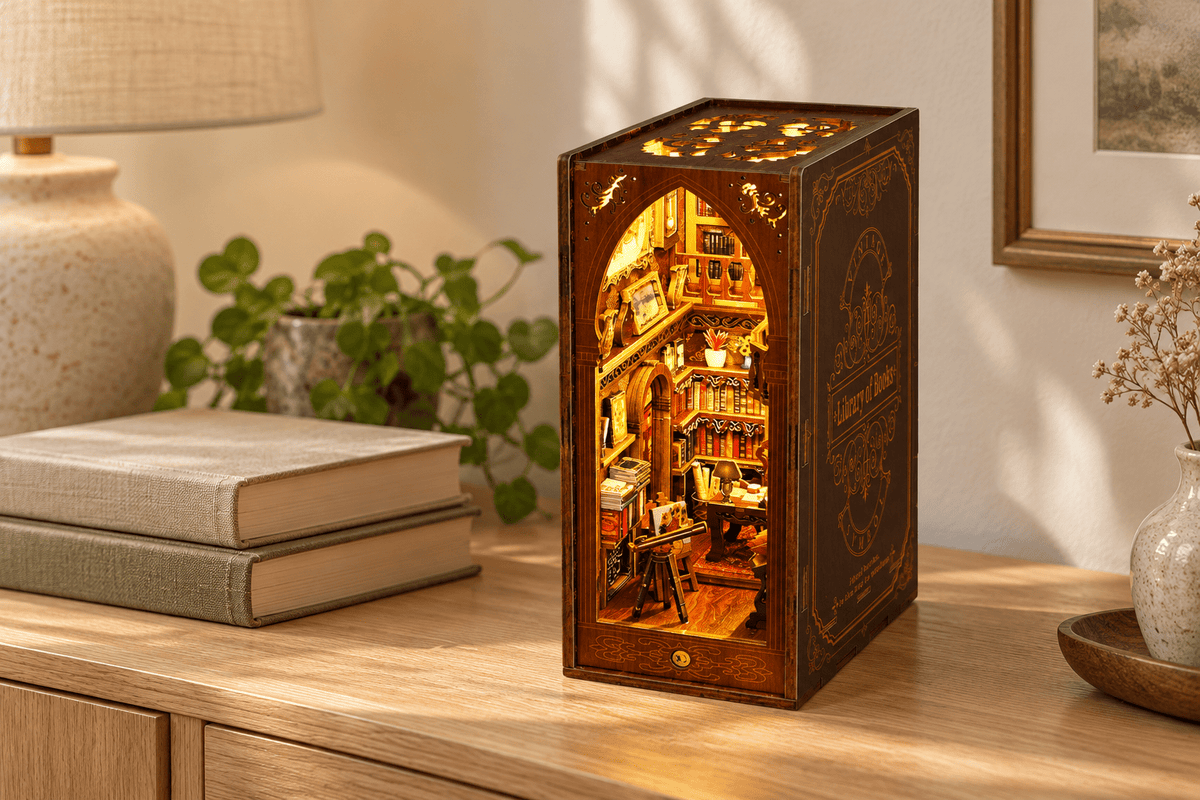
You can love the view into a tiny library without owning a wall of books. A book nook can live on a sideboard, a desk or a bedside cabinet—as long as its shape suits the surface and the display leaves room for everyday life.
The useful question is not simply “Will it fit?” It is “Will I enjoy seeing it here, and can I still use this space?” Start with that, and a miniature can feel at home beyond the bookshelf.
Let the model choose its best viewing position
Book nooks are made to draw your eye through a front opening. Before choosing a surface, look at the finished model from the place you will usually sit or stand. Can you see into the scene, or are you mainly looking down at its roof? Move yourself first; then decide where the model belongs.
Our example is Library Nook, a DIY wooden miniature library with brown book-like sides, gold-coloured ornament and a pointed front arch. Its decorated side is part of the appeal when it stands on its own. The current listing gives an approximate assembled size of 24 cm high × 10 cm wide × 18 cm deep. That narrow front can be misleading: the surface still needs to accommodate the full depth.
Mark that footprint on a piece of paper and place it where you are considering displaying the finished model. Leave extra room to lift it safely and reach any controls. Nothing should overhang. If you turn it slightly to show the side, check the footprint again—the space it occupies changes with the angle. Keep the model on a stable, level surface; do not assume it can hold up books as a bookend.
On a sideboard: give it a clear patch of its own
A sideboard is a useful starting point because it often lets you view a miniature while standing or walking past. Place the model with its opening facing the room, then check the view from the sofa as well. A small turn can reveal the decorated side without hiding the interior.
Keep the immediate background quiet. A plain wall makes the outline easier to read than a busy picture directly behind it. Try one nearby group of full-size books, separated from the model rather than pressed against it. The miniature already contains many little objects; the surrounding furniture does not need to repeat that density.
Use the sideboard normally before calling the arrangement finished. Open the cupboard, pull out a drawer and put down whatever usually lands there. If you brush the model or have to move it each time, choose another patch. A display works best when it does not ask you to be careful every time you walk into the room.
On a desk: keep the working area generous
A desk offers a closer, seated view. Try a back corner with the opening turned towards your usual position, while leaving enough space behind the model for access. Keep it clear of the route your laptop lid, monitor arm or task lamp needs to move.
Then do a normal piece of work. Open your notebook, move the mouse and slide your chair in. The display should sit beyond that working area. A miniature that steals the space you use to write will soon feel like clutter, however much you like it.

Let one thing nearby echo the model: perhaps the warm wood of a pencil or a plain brown notebook. There is no need to turn the entire desk into a matching library scene. Keep drinks in a separate area, and avoid putting the model where a charging cable will drag against it.
Beside the bed: protect the space your hand reaches for
A bedside cabinet can make a miniature part of a reading corner, but it is also a busy landing place. Your book, glasses and lamp need to be easy to reach without your hand passing over delicate details. Put those everyday objects in position first, then see whether a separate patch remains for the model.
Check the view from the pillow and from a seated reading position. If the cabinet is too low to see into the scene, or so small that the model sits near the edge, a sideboard may be a better home. Avoid stacking it on books to solve a height problem; a level furniture surface provides a simpler, steadier base.

Library Nook has LED lighting, but treat the lit interior as a display feature, not a replacement for a reading lamp. Use the lighting according to the kit instructions. It is worth enjoying the arrangement in daylight too, when the brown cover and printed gold details give it a different presence.
Try the place before you style it
Choose the surface where the model has a clear view, full support and the least competition with everyday tasks. Live with a paper footprint there for a day before moving the finished piece into place. You may find that the quiet corner of a sideboard works better than the most photogenic spot beside the bed.
Once you have chosen a home, our guide to displaying and protecting a finished book nook covers longer-term care. If your next project might be a wider, open-sided scene, the book nook, dollhouse and diorama comparison can help you think about the different formats.
A bookshelf is one good home for a miniature library. It does not have to be the only one.
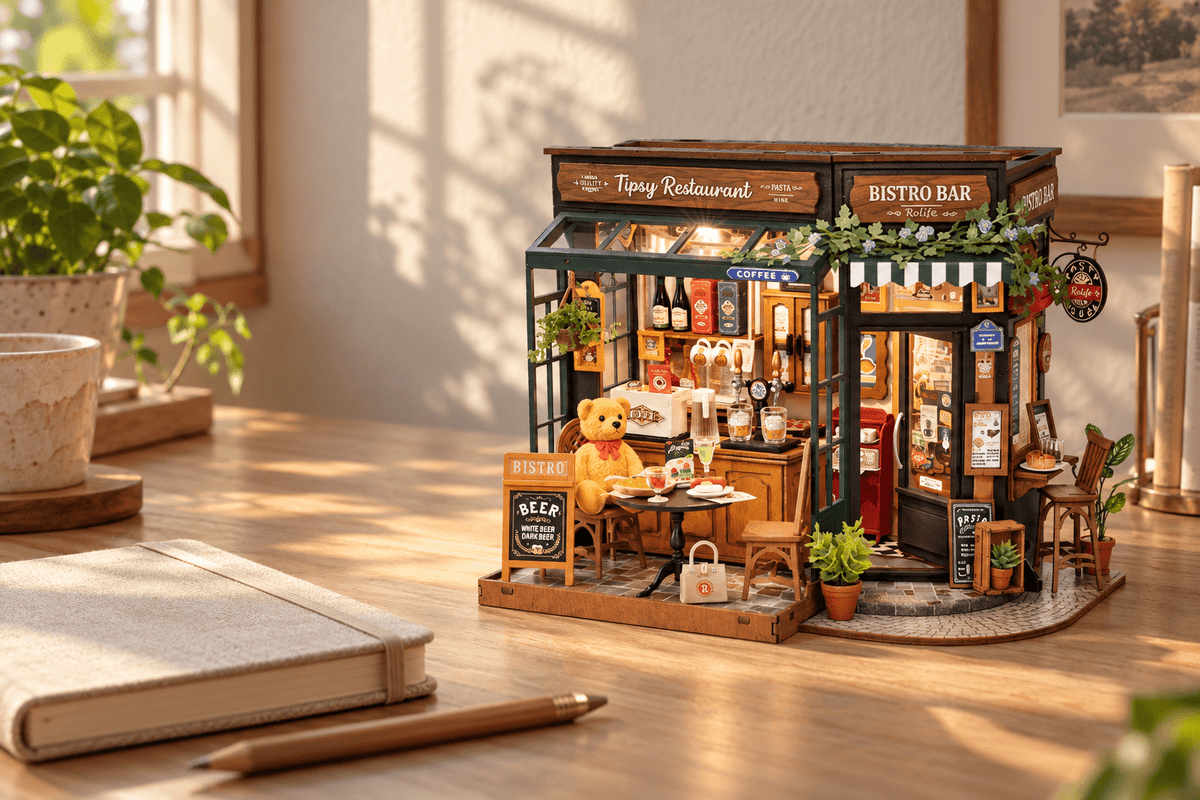
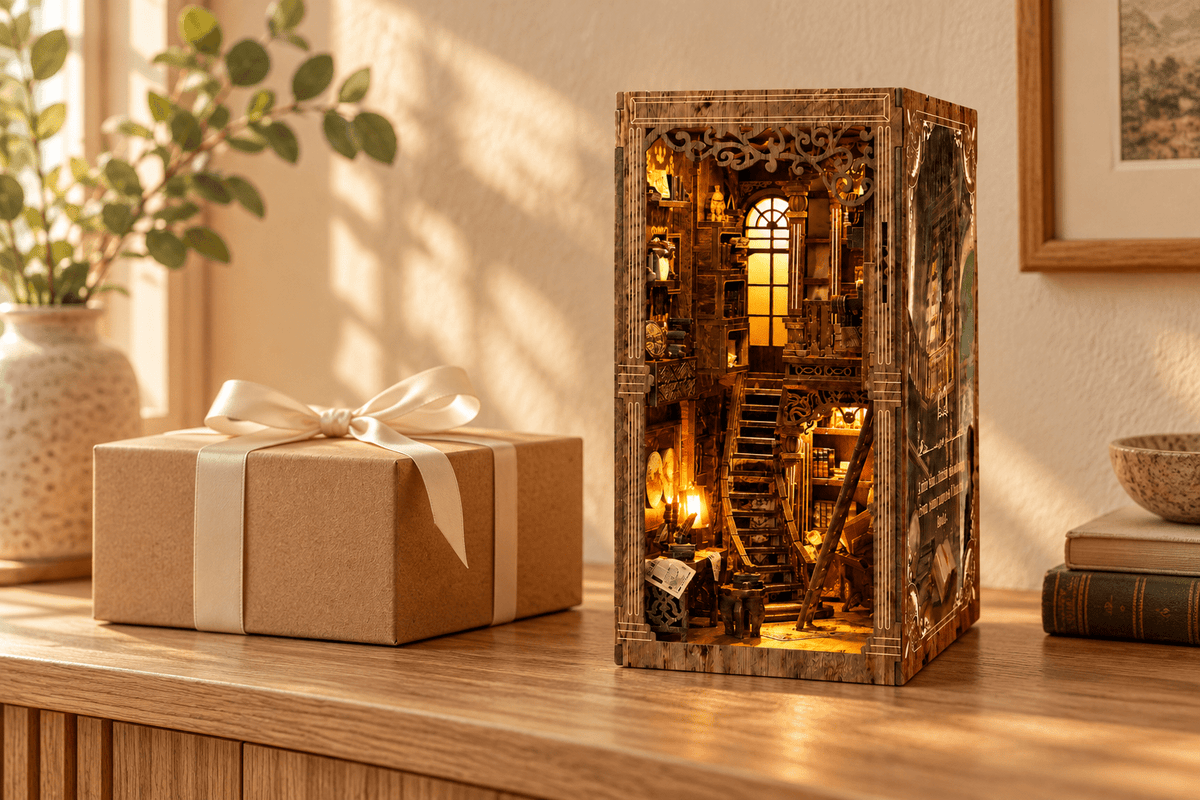
Image note: The cover and two article scenes were created with AI using real HiNooki Library Nook product photographs as references. They illustrate possible display settings, not kit contents. Library Nook is supplied as a DIY kit requiring assembly. Check the product page for original photographs and current specifications.
Partager:
Your Second Miniature Kit: What to Choose After Your First Build