


Paper collage, hand stitching, phone photography, air-dry clay and miniature building all let you make something personal without drawing. Start with the kind of action that appeals to you. Do you like moving colors around, repeating a small motion, noticing details, shaping a material or following a plan?
Choose one of the small projects below for your first try. Each gives you a way to experience the hobby before filling a cupboard with supplies.
Which hobby would suit your evening?
| Try this | If you enjoy | Plan for |
|---|---|---|
| Paper collage | Color and arranging | A flat surface and paper scraps |
| Hand stitching | Repetition and texture | Good light and close-up work |
| Phone photography | Looking for details | Time to choose your best images |
| Air-dry clay | Shaping with your hands | Cleanup and a place for drying |
| Miniature building | Following steps and assembling | Several sessions and storage for the work |
1. Paper collage for playing with color
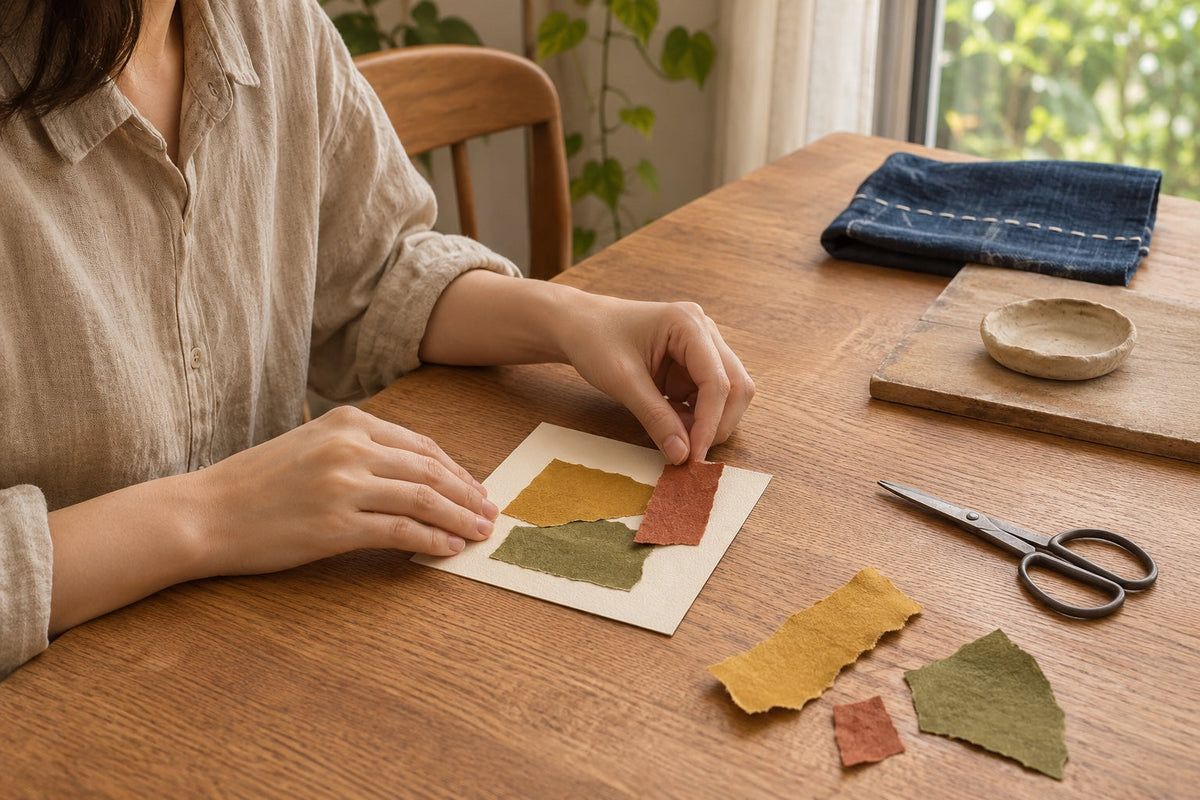
Gather a glue stick, a card and three scraps of colored paper. Saved wrapping paper and plain packaging can work. Choose one long shape, one broad shape and one small shape, then lay them on the card. Turn the long piece sideways. Overlap two edges. Leave an empty corner.
Try three arrangements and take a quick photo of each before gluing your favorite. Keeping the pieces loose lets you change your mind, so this is a useful first choice if you enjoy decorating a shelf or arranging flowers.
A smooth card and thin paper are easier to glue flat. If thick scraps curl up, press the finished card under a clean sheet of paper and a book while the adhesive dries, following its instructions.

Afterward, notice whether you wanted to keep rearranging the pieces. If you did, try a second card with the same colors. You already have a direction to explore.
2. Hand stitching for rhythm and texture
Start on a scrap of woven cotton with a smaller fabric patch on top. Use a needle and thread suited to the fabric, then make a short line of running stitches through both layers. Bring the needle up, move a little way along the cloth and take it down again. Repeat to make a line of small dashes. Pull gently enough that the fabric stays flat.
Try one edge of the patch first. A contrasting thread makes the stitches easy to see and lets small variations become part of the pattern. Keep the needle in a pincushion or needle case when you stop.

This is a good trial if you like a repeated hand movement. Close work takes patience, and fabric can bunch if you pull hard. Before tackling a garment repair, use the scrap to decide whether you enjoy handling the needle and watching a line grow.
3. Phone photography for noticing what is already there
Choose a tiny theme around home, such as curved handles, leaf shadows or three things in the same color. Use your phone to photograph each subject from two positions. For a mug, try its height on the table, then move above it. For a shadow, move closer until the surrounding clutter leaves the frame.
Pick three pictures that belong together. Look at what changed between versions. Perhaps moving sideways separated a handle from the background, or a closer view made a leaf look abstract. Save the three as a small album.
Photography suits curiosity and observation. It is easy to start with a phone you own, though choosing and organizing the pictures is part of the hobby too. Try that part during the first session so you know whether you enjoy the whole process.
4. Air-dry clay for making a small object
Choose a clay labeled for air drying and protect the table with a washable work surface. For a first trial, shape a small decorative dish for dry trinkets. Press a hollow into a ball of clay with your thumb, then turn it slowly while pinching around the sides. Keep the base and walls reasonably even and leave the shape simple.
Follow the clay’s own instructions for handling, drying and finishing. Set aside a spot where the piece can dry undisturbed. Plan to use it for small dry objects such as a ring. Crayola’s air-dry clay instructions, for example, exclude contact with food and liquids. Read the manufacturer’s clay instructions.
Clay gives you a shape you can turn in your hands, and you can adjust it as you work. Its trade-off is the waiting and cleanup. Include both when deciding whether it fits the place and time you have.
5. Miniature building for a project with a plan
A miniature kit gives you a scene to work toward and instructions for getting there. The interest is in fitting, shaping and arranging many small parts. For a first session, read the opening stages and choose a small assembly that the instructions allow you to complete, such as a piece of furniture. Keep the rest of the parts labeled and protected.
Look at the making steps as closely as the finished photograph. Cathy’s Flower House, for example, combines furniture assembly with shaping paper foliage and arranging plants inside a greenhouse. Someone who likes those tiny tasks may enjoy returning to it over several sittings. Check the product’s age guidance, instructions and required supplies before choosing it.
Leave a place for the unfinished work as well as the finished model. A project that needs the dining table every evening can be harder to restart if everything has to be packed away. Our guide to storing an unfinished miniature kit explains how to keep your place and protect what you have built.
Decide what to try again
After your first attempt, write a single sentence about the part you wanted to keep doing. “I liked moving the colors around” points toward another collage. “I liked the stitches, but threading the needle was frustrating” gives you a specific thing to practice or ask for help with.
Then check the practical side. Could you put the materials away easily? Was the light comfortable? Is there a place for the object while it dries or waits for the next session? Adjust one of those conditions before your next try if it got in the way.
You can return to the same small exercise with different colors, a new subject or another scrap of fabric. That second attempt will tell you more about your interest than a bigger shopping list.

Teilen:
7 Housewarming Gifts for Small Apartments