


A weekend with a book nook: what building one is actually like
Two quiet days, a pot of tea, and a small lit-up world that ends up living between the paperbacks.
I cleared the kitchen table on a Friday night, made a pot of tea, and opened a box I had been saving for a rainy weekend. Inside was a book nook waiting to become a small lit-up scene, the kind that eventually slots between the paperbacks on a shelf so it looks like a doorway opening into another street. I had put together a few things before, but never one of these. What follows is not a step-by-step guide. It is an honest account of what the two days actually felt like, in case you are wondering whether it is your kind of weekend.
What the book nook experience is like on day one
The first surprise is how tidy everything is. You lift the lid and find flat boards of pre-cut wood, small bags of parts sorted by stage, and a booklet of instructions. There is a quiet pleasure in laying it all out and just looking at it before you touch anything. It feels less like assembling furniture and more like being handed the pieces of a very small stage set.
I spent the first twenty minutes doing nothing productive at all. I read through the booklet, matched the numbered bags to the diagrams, and pressed a few pieces out of their frames to feel the weight of them. That slow start turned out to be the right instinct. Once I understood roughly where the project was heading, the building itself felt calm instead of frantic.
A few things stood out in that first hour:
It is quiet work. No power tools, no noise, just your hands and a bit of glue. The loudest thing in the room was the kettle.
The pieces are small but forgiving. Wood has a warmth that plastic does not, and dry-fitting before gluing means most mistakes are easy to undo.
Reading ahead pays off. The projects that go smoothly are the ones where you glance at the next two steps before committing to the current one.
The rhythm of building: slower than you expect, in a good way
By Saturday morning I had settled into a rhythm, and that rhythm is really the whole point. You place a wall, hold it while the glue grabs, and move on to the next. There is a lot of small, repetitive handwork, and instead of being boring it becomes the thing you came for. My phone drifted to the far end of the table and stayed there for hours, which almost never happens.
The scene starts to feel real earlier than you would guess. A blank wall becomes a shopfront the moment the little window frame goes on. A bare floor turns into a room once the first tiny furnishings are in place. Each of those moments gives you a small lift and pulls you toward the next one, which is why an afternoon disappears without you noticing.
If you have never done a project like this, it helps to know how the effort tends to spread across a build:
| Stage | What you are doing | How it feels |
|---|---|---|
| Opening and sorting | Laying out parts, reading the booklet | Relaxed, a little anticipatory |
| The main structure | Walls, floors, the shell of the scene | Steady and satisfying |
| The details | Furnishings, signage, the small touches | Absorbing, the most fun part |
| The lighting | Threading the LEDs, the first switch-on | The payoff |
None of this is difficult in the way people fear. It asks for patience and a steady hand far more than any particular skill, which is exactly why it makes such a good first project. If you want to start with something built to be approachable, the beginner kits are the gentlest way in, and the wider book nook collection gives you a sense of just how many little worlds these turn into.
The details are where the hours quietly vanish
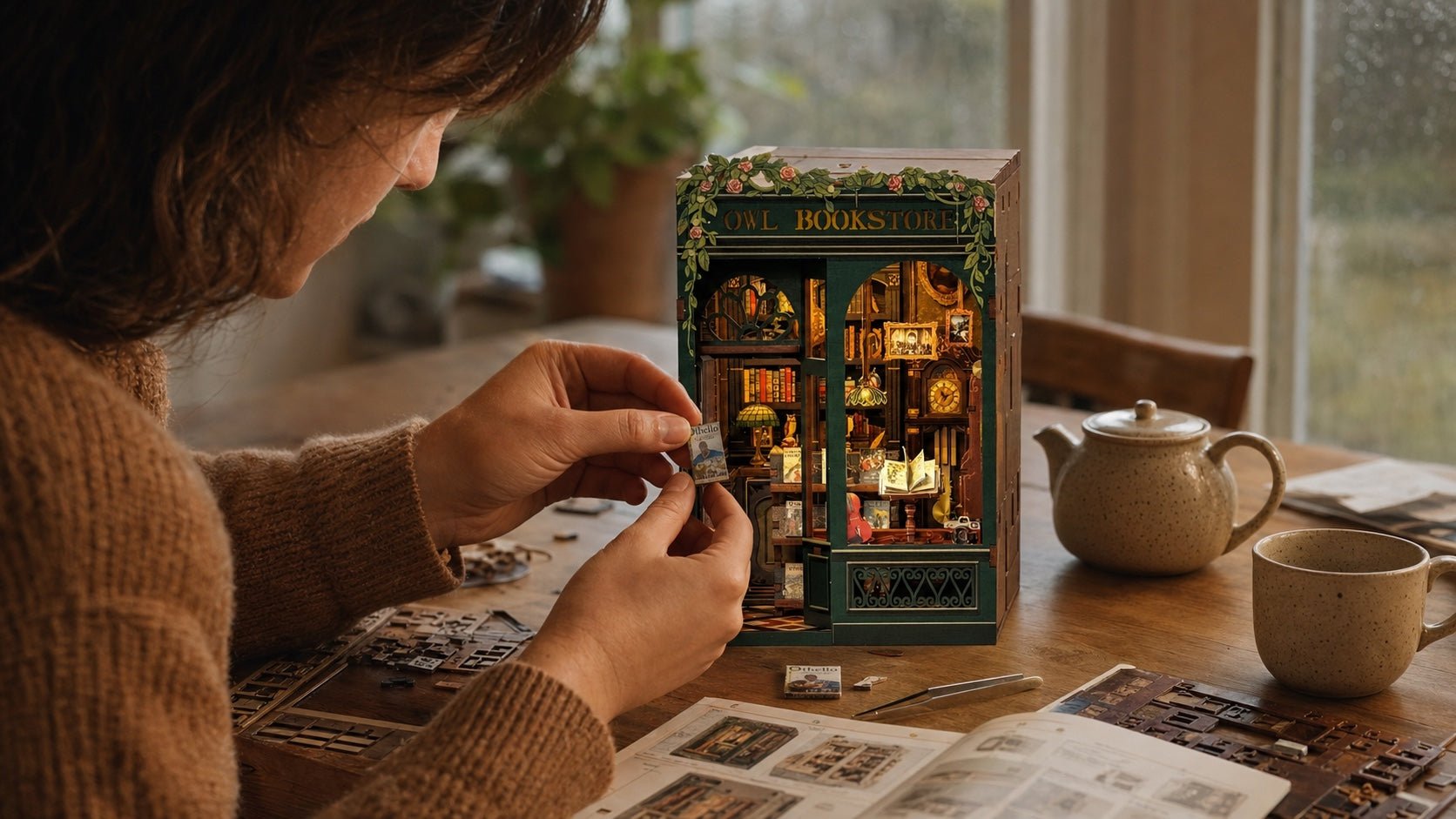
My favorite stretch of the whole weekend was the fiddly middle. This is where a plain wooden box turns into a place with a personality: the tiny books on the shelves, the sign over the door, the props that make a scene feel lived-in. I was building a bookstore theme, and by Saturday evening there were miniature spines lined up along the walls and a warm little counter where you could imagine someone standing.
You do not need to be an artist for any of this. The parts are shaped and printed so they fall into place, and your job is mostly patience and a good pair of tweezers. But there is real room to make it yours. I nudged a couple of pieces slightly off-center because it looked more natural, and that small freedom is a big part of the charm. If a cozy, book-filled scene is the kind of thing that pulls at you, the book house and library collection is full of them, and the Owl Bookstore is a good example of how much character these little storefronts can carry.
What surprised me most
I expected the building to be pleasant. I did not expect it to be genuinely restful in the way that only fully-occupied hands can be. There is a specific kind of quiet that comes from a task that is engaging enough to hold your attention but gentle enough that you never feel behind. It is closer to gardening or baking than to a chore. When I looked up, hours had gone by and I felt better than when I sat down.
Lighting it up: the moment it all pays off
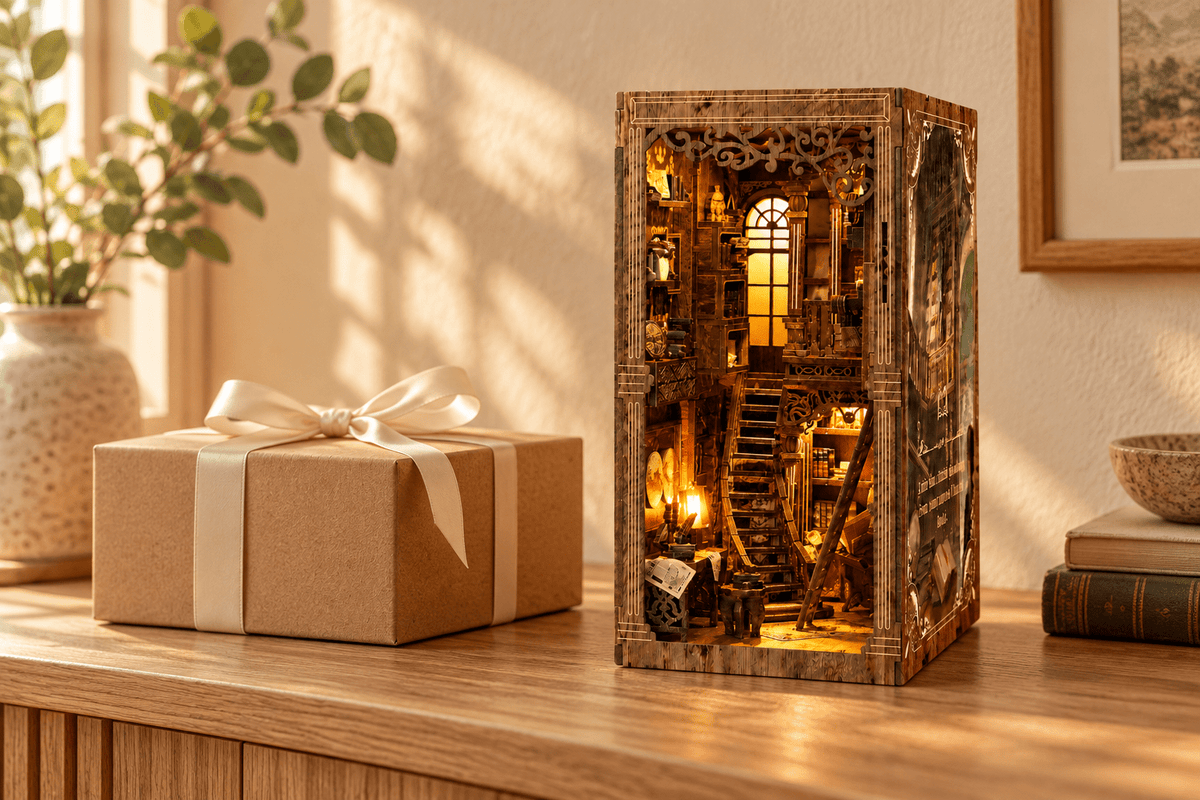
Most of these kits include a small string of LED lights, and threading them through the finished scene is the last real step. It is a little fiddly, tucking the wire out of sight so only the glow shows, but it is worth every minute. When I finally turned off the kitchen lights and flicked the switch, the whole thing came alive. Warm light spilled out of the little windows, the shopfront glowed, and suddenly it was not a wooden box on a table anymore. It was a scene you could get lost looking into.
That is the moment everyone talks about, and it lands exactly as promised. I carried it over to the bookshelf, slid it into a gap between two hardbacks, and stepped back. From across the room it reads like a tiny street that has always been there, hiding among the books. I keep catching it out of the corner of my eye and smiling.
Would I recommend a weekend like this?
Without hesitation, if the description already appeals to you. It is not a race and there is no way to fail it. You trade a weekend of scrolling for a weekend of making something with your hands, and at the end you have a small, glowing world to keep. It makes a lovely thing to build alone with a podcast on, and an even nicer one to build across a table from someone else.
If you are ready to pick your first scene, the beginner collection is the friendliest starting point, and browsing the full book nook range is the easiest way to find the little world you most want to light up on some quiet weekend of your own.
Find the little world you want to light up
Pick a scene, clear the table, and trade a weekend of scrolling for one you build with your hands.
Shop book nooks →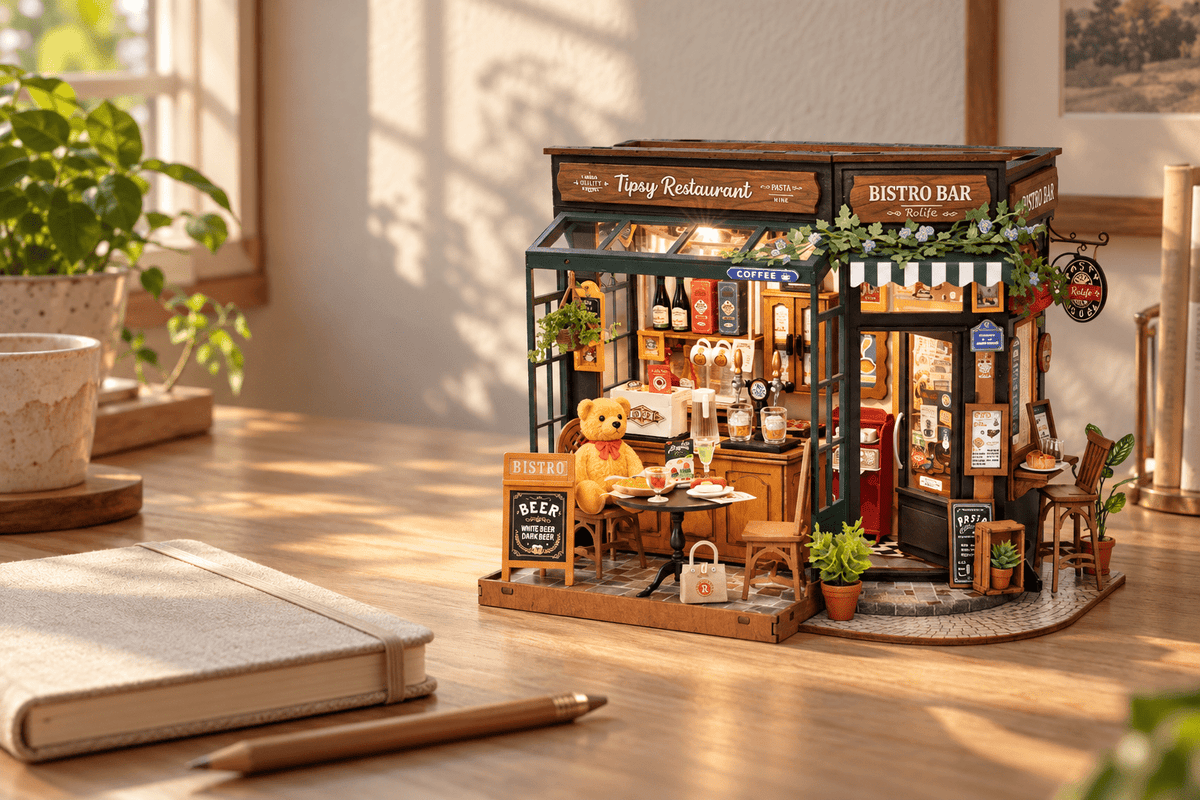

Share:
Book nook vs. dollhouse vs. diorama: what's the difference?
Book nooks for fandom lovers: wizarding, anime and fairy-tale worlds