


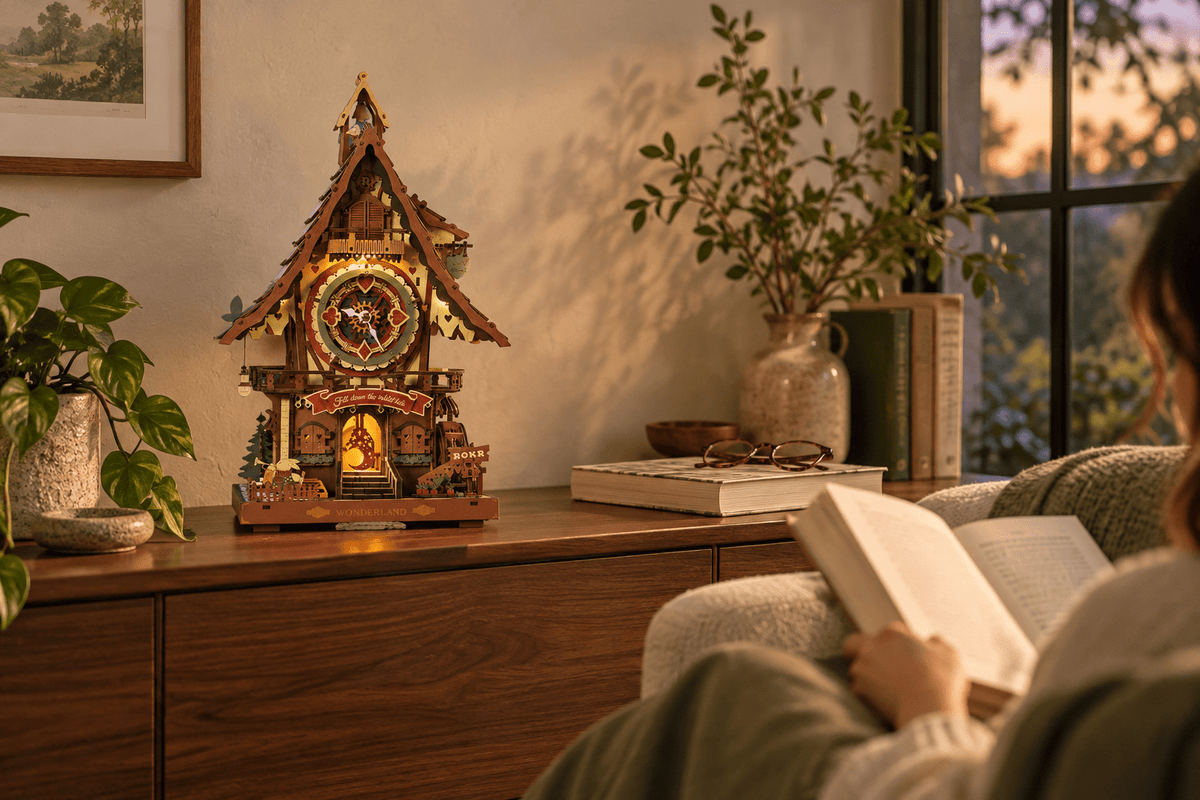
When choosing a cuckoo clock kit, check six things before the design wins you over: whether it is a complete kit, whether it tells time, how the sound is controlled, what powers it, where it will fit and what the assembly involves. These details determine whether you are buying a satisfying project that suits your room—or a beautiful clock you cannot comfortably use there.
This guide is for adults choosing a clock to build, with two HiNooki examples: Cuckoo Clock and Christmas Cuckoo Clock. Both are DIY kits, not clocks delivered fully assembled.
1. Check what “kit” actually includes
A search for “cuckoo clock kit” can lead to very different purchases: a complete wooden model, replacement movement parts, plans for making a case or a finished clock. A photograph of a completed house does not tell you which one is in the box.
Look for a parts list and assembly instructions that cover both the clock body and its working components. If the listing describes only a movement, dial or hands, you may still need to supply the case and other parts. If it offers plans, check whether physical materials are included at all.
Before buying: make sure you can identify the complete project, the instructions and anything you must obtain separately. For a gift, this matters just as much as the finished design.
2. Separate timekeeping from the show
A moving bird, glowing doorway and swinging decoration are appealing, but they do not by themselves establish that the model keeps time. Look for an explicit description of a working clock, then check which other elements operate automatically and which you trigger yourself.
HiNooki’s Cuckoo Clock is described as a working woodland clock with an hourly chime, a crescent pendulum and a turning waterwheel. A hidden switch in the bottom stair also brings out the cuckoo and its call. Those are distinct features: the manual demonstration is not the same thing as the hourly routine.
The word “mechanical” does not settle the power question or mean every part of the timekeeping mechanism is wooden. If you specifically want a traditional weight-driven clock, or a clock with no electrical supply, look for that specification rather than inferring it from visible gears.

3. Match the sound controls to the room
A cuckoo call can be welcome in a living room and distracting beside a bed or a work-call setup. Check whether the hourly chime can be switched off, whether music has a separate control and whether any night setting is automatic or manual. Do not assume one switch silences every function.
Cuckoo Clock’s listing confirms that its hourly chime can be turned on or off. A separate pull cord controls the warm lighting around the dial and entrance. Christmas Cuckoo Clock has an hourly bird action and a pinecone-pendant control for lighting and music, but its listing does not establish the same chime-off or night-mode options. Confirm those controls before choosing it for a room where quiet hours matter.
Neither a still image nor the absence of a noise warning proves that a clock is silent. If sound is the deciding factor, ask for an operating demonstration and confirmation of the controls before ordering.
4. Plan the power supply
Check the exact model rather than assuming all wooden clock kits use the same supply. Cuckoo Clock specifies USB Type-C power, with a cable to be supplied separately. Christmas Cuckoo Clock specifies three AAA batteries, which are not included.
For the USB model, plan where the cable will reach and confirm the required supply in the instructions. For a battery model, keep access to the battery compartment when arranging the display. Do not assume batteries are rechargeable or that a USB connection is available unless the listing or manual says so.
5. Measure the display space, not just the shelf
The listed assembled dimensions are 21.1 × 17 × 34 cm for Cuckoo Clock and 24.8 × 14.9 × 27.4 cm for Christmas Cuckoo Clock. The woodland design is taller; the Christmas design has a wider listed dimension. Check each product’s dimension diagram when matching those measurements to your furniture.
Leave room beyond the model itself to reach the controls, supply power and handle it without catching the roof or decorations. Keep nearby books, plants and fabric clear of moving parts. A shelf that just contains the outline may still be awkward to use.
Decide whether you will view it sitting down or standing. You should be able to read the face and enjoy the bird without looking sharply upward. If you intend to hang it, confirm the mounting method and hardware; a house-shaped clock shown on a console is not evidence of wall-mount compatibility.

6. Choose the assembly work you want
Piece count is useful for identifying the scale of a project, but it does not rank difficulty on its own. Cuckoo Clock lists 435 pieces and an estimated 6–12 hours; Christmas Cuckoo Clock lists 293 pieces and about 8 hours. The smaller piece count does not make the second kit an automatically quicker or easier choice.
Before ordering, look at the instructions for the exact model. Check how the frame, moving components and clock hands are assembled, and when the instructions call for alignment or function checks. This is a different commitment from arranging purely decorative miniature furniture.
Allow time to follow those checks before closing up or decorating the structure. Treat the listed build time as an estimate, with room for pauses and adjustments. If you enjoy careful fitting and seeing an assembled mechanism operate, that work can be part of the appeal; if you mainly want a finished clock for a particular date, a DIY kit adds a project to the purchase.
Which style fits your plans?
Choose Cuckoo Clock if the tall woodland design suits a year-round display and its confirmed chime control and USB setup fit your room. Consider Christmas Cuckoo Clock if the wreath dial, sleigh and festive music are part of the attraction, and its battery supply suits your display spot.
Before deciding, write down your must-haves: a complete working kit, acceptable sound controls, a practical power source and a measured place to display it. Then choose the design you would enjoy building and living with.
Product details checked against HiNooki listings on November 1, 2026. This is a specification-based buying guide, not a hands-on test. The cover and article scenes are AI-created using photographs of the real kits as references; furnishings and room props are not included.

Share:
Miniature Coffee Shop Kits: Static vs. Mechanical
24 Small Advent Calendar Fillers for Adults